You are currently logged-out. You can log-in or create an account to save favorites and more. more info
The Spirit of the Mahayana, Serial 00033
AI Suggested Keywords:
The talk delves into the essential teachings of Mahayana Buddhism, specifically focusing on the doctrine of interdependent origination, as taught by Lord Buddha. It emphasizes the significance of understanding this doctrine to grasp the essence of Buddha's teachings. The discourse distinguishes between outer and inner interdependent origination, illustrating their importance with practical examples and the process through which they relate to Buddhist concepts of karma, defilements, and suffering. The speaker underscores the teachings of Nagarjuna on interdependent origination as crucial for deepening one's practice and knowledge in Buddhism, emphasizing the interconnected relationship between ignorance, karma, and human experience within the cycle of samsara.
Referenced Works and Texts:
-
Nagarjuna's Teachings: Nagarjuna's exposition on interdependent origination is highlighted as key to understanding the core of Buddha's teachings. It is suggested that studying his works provides an advanced comprehension of the interconnected nature of existence.
-
Four Noble Truths: The talk refers to the Four Noble Truths as central to the Lord Buddha's teachings and underscores their integration within the twelve aspects of interdependent origination, linking them to the cycle of suffering and liberation in Buddhism.
The speaker's emphasis on these teachings aims to foster a deeper understanding of the Mahayana path through the lens of interdependence and emptiness.
AI Suggested Title: Understanding Interdependence in Buddhism


Teaching by Deshung Rinpoche (Dezhung Rinpoche III)
Interpreted by Kargyal (= Kalsang Gyaltsen, now Khenpo Kalsang Gyaltsen?)
Madison at 94th Street, NYC
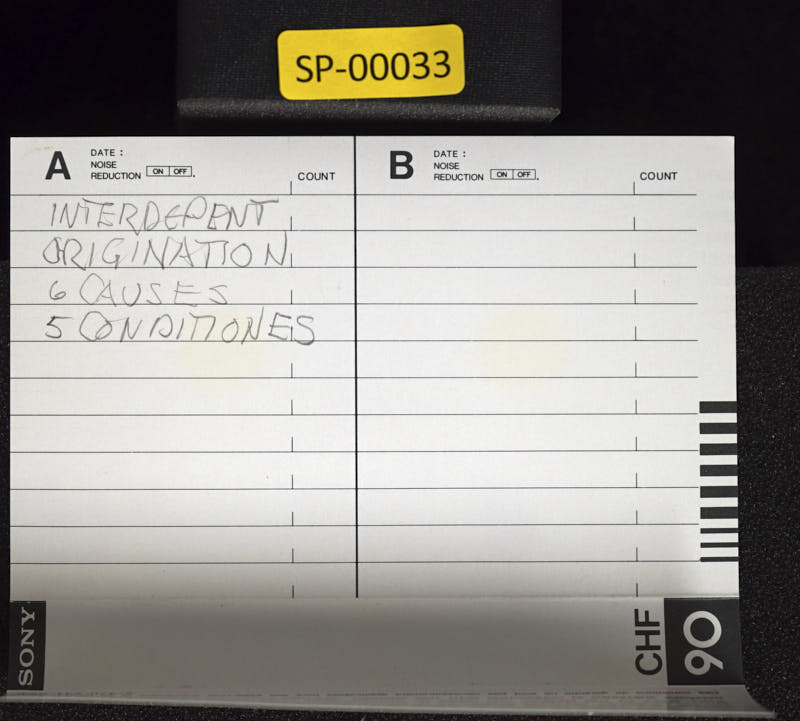
Interdependent origination—6 causes, 5 conditions (earth, water, fire, air, space), inner and outer qualities, 3 defilements
It's not that much. It's not that much. It's not that much. He didn't send me a joke at him already. He didn't tell me that doesn't possibly get it. It's a little special. to come again for Mahayana teaching.
[01:16]
Before we get this teaching, we have the right attitude and the right intention in order to receive Mahayana teaching. Actually, number two advice, we are very fortunate to have this kind of opportunity to receive the Buddhist teaching. It is very difficult to get the Buddhist teaching through the qualified teacher and having the right opportunity to study and reflect on that Buddhist teaching. So having even the little chance and the little opportunity to study and reflect on the lord buddha's teaching which is very great and vast so because of that Rinpoche he likes to give according our jayat research centres the members to cause some of the Mahayanas
[02:38]
the essential point of the Mayan teaching. So what the Rinpoche will give the teaching, it will be in Tibet language, it is quite difficult to understand. For everyone, we have to go through the translators. So whatever Rinpoche gives the teaching, actually it is not. It depends on Lord Buddha's teaching. It's very important to listen very carefully. Whatever we receive with teaching, it's necessary to write down and keep in our mind. Just for example, having our delicious food, prepare everything ready to eat but without the taste of the food it's difficult to understand what is the taste and it won't be sufficient for oneself.
[03:54]
Like that, just having the teaching from the teacher but without studying and without reflecting on that. It's just having the delicious food but without eating. That means after receiving the teaching, it's necessary to study and reflect and meditate, no matter how much we receive teaching. that we have to apply that teaching on our mind. So that's very important.
[04:58]
It's been a long time for a long time. [...] That's how we're not thinking about it. Choose the truth, and choose the truth. Yes. You're not going to die. [...] We have to do it.
[06:05]
We have to do it. [...] We're going to get back to work. We're going to [...] get back to work. So, so so so
[07:28]
There are several different types of [...] different types When I was born, I was born. [...] So, we had a lot of people who [...] had a lot of people.
[08:57]
If you don't want to, if [...] you don't want to, We have a lot of people who live here. [...] ... ... ... ...
[10:04]
So tonight, what the Rinpoche will give the teaching is actually based on the interdependent origination. The interdependent origination is the essence of all the Lord Buddha's teaching. And also one of the great scholars Nagarjuna, he said in his book, those who understand about the nature of interdependent origination, which they understood the essence of Lord Buddha's teaching, and also they seen the Lord Buddha and all the other people and pictures of the Buddha.
[11:34]
In other terms, they also mention those who understand about the nature of interdependent origination, then they understood about all the essence of the teachings. There is not any other knowledge beside the interdependent ordination. So the interdependent ordination is one of the most profound and most extensive teaching among all the Lord Buddha's teaching. It is difficult to explain within a short time. But tonight Rinpoche will give in short and in brief teaching on the interdependent ordination.
[12:44]
So in order to study that interdependent ordination in knowledge, first we have to know about two things that interdependent ordination is, which is the outer and inner. interdependent ordination so first Rinpoche will explain about the outer interdependent ordination that from once the consciousness out from the seed of the plant after the about Buddha's Tense and Wisdom, all the phenomena in the living beings are included in the Ksenoti, are interdependent originations. There is not any such thing besides interdependent originations.
[13:45]
So interdependent originations means that everything is dependent on each other. There is not such thing that themselves or they naturally appear dependent themselves, independent. It means, for example, the outer interdependent originations, whatever we planted the seed, we can get the same type of fruit or the result. If we plant the seed of rice, we can get the same type of rice. Or if we plant the seed of wheat, we can get wheat, the result.
[14:47]
Same types, you know, whatever we plant the seeds, everything is grew according to that seed. If we plant the poison, that result also will appear, the poisons, medicines, the seeds appear, that's, you know, that's medicine, fruit. So same things, whatever good and bad deeds, also that will come, that same, the action result. It never, you know, mistake about the cause and result it's unmistakable so all things all the phenomenons are interdependent you know included in that after interdependent ordinations so that's for example but he gives just only one example
[16:00]
which is that, you know, you plant the seeds of rice or any that's wheat, anything. First, there are seven different type of seeds which depend on each other, which they call seven crosses. Seven crosses? Seven crosses. The seven crosses are dependent to each other. First, because it's the seed. So after we, you know, planted the seed, then it grew the plant, which is the second, you know, plant is the result of the plant. It's the result of the previous seed. After the plant, then it grows, how to say it, Leap.
[17:04]
Yeah. And then after leaves, then the... There are seven... Stamps. [...] Then the fourth one is they inhibit, they say, essence. And the fifth one is... Then the flowers. Yes.
[18:06]
After that, then the seed. Seed, you know, that's it. The result, the final one. The fruit one. Yeah, the fruit one. Six or seven, six. So, you look, don't look. Orange [...] First one is feet, and second one is quant, third one is stent.
[19:32]
fourth one is the leaf and fifth one is essence sixth one is flower seventh one is fruit so those are dependent to each other various ones what do you mean by the essence? essence means Just to re-pour the flowers. How do you... what do you say? Do you have any... Can you repeat seven... seven poses? The first one is seed. Second one is plant. Third one is sprout. No, no, no, no, no, no, no, no, no.
[20:59]
In Tibet, they say Ninh Bok. So Ninh Bok means exactly the essence in English. So those are the seven causes. These seven causes are also dependent on each other. It never appears itself. They have to be the right cause and the right condition. So someone they said that, you know, some, according to the Hinduism systems, someone they said, all the phenomenon living beings, all the existence are, you know, created by some gods, but it's not true. There is not that thing that, you know, created. So someone they said, it's appeared that, you know, natural, there is not such things to depend on each other. That's also difficult to say that everything is dependent to each other.
[22:05]
So there is not that thing independent. So that's why the Lord Buddha's teachings, they say, everything, the phenomenon, the living beings, everything is dependent to our interdependent organizations, relationships with each other. So that's why I believe The first one is seven coasts. And then the second one is six conditions. The six conditions are... The first one is earth. The second one is water. The third one is fire. The fourth one is air. Fifth one is space. Sixth one is time. So these are the six conditions.
[23:11]
It's not sufficient having only these five causes, but it's also necessary to have these six conditions. Without having these six conditions, it never appeared. the you know the right roots the first the earth it makes that you know the ground of the foundation then these waters it does they collect that you know the the good conditions are the necessary things then this the third one's air it grows up you know The fourth one, the fire. And we're having that, you know, the air, it doesn't, how to say, rotten the...
[24:25]
Yeah, it never spoiled with having that, you know, the air. And then the, the space. Pardon? What? Water thing. Uh-huh. Clack. Clack. Uh-huh. airs, with having the airs, it doesn't spoil. And then with having this fire, it increases. And then with having the space, then it loses everything. And then with having this fire, the elements, it's also necessary to have some time. according that's how much the duration they need weeks and months or years we need to time with the so these are the six are the we call six condition you know so all together seven causes and six conditions having these then everything's grow that
[26:02]
with the interdependent ordinations, the old thing. That's just for one example. The same way all things, you know, meaning everything has to go through the, you know, the causing condition. So having this type, the condition, we call the interdependent ordination of the thing in Degarandama. we incubate us, which means that we are related to each other, or dependent to each other. So that is what we call the outer interdependent ordination. So that's with having these causes and conditions, grows all, everything, the phenomena, but the nature of all the phenomena, is this emptiness.
[27:03]
So then emptiness, the interdependent origination is also the emptiness. There is not such things, the single or the solid or the independent means that there is not such things themselves. grow up everything. So then the emptiness and interdependent originations are related to each. Those two are the same nature. So that is just the outer interdependent ordination. What are you doing?
[28:09]
What are you doing? What are you doing? What are you doing? Troa, stepa, lemba, sipa, yewa, gasha. So that's it, in the king of [...] the king. This is what we are doing. We are doing this. We are doing this. We are doing this.
[29:16]
We are doing this. [...] I don't want to know what it is. I don't want to know what it is. I don't want to know what it is. I don't want to know what it is. In Chinese, I talk so many, I talk to you. These are things that I talk to you about. I don't know.
[30:17]
I can't. [...] When I was a kid, I was a kid. [...] And then I was like, oh my God. And then I was like, oh my God. And then I was like, oh my God. And then I was like, oh my God.
[31:22]
And then I was like, oh my God. And then I was like, oh my God. And then she said you can talk. In London, it was 72 years ago. It was 24 hours ago. It was 72 years [...] ago.
[32:24]
It was 72 years ago. And then, that's it. [...] And you're going to get a little bit to see what you're going to do. And you get a little bit to see what you're going to do. And you're going to get a little bit to see what you're going to do. And you're going to get a little bit to see what you're going to do. And you're going to get a little bit to see what you're going to do. You're going to get a little bit to see what you're going to do.
[33:24]
This is the first time I was born. [...] And he gave him a little bit and he gave him a little bit. He [...] gave him a little bit. We had to go to the university, and we had to go to the university.
[34:30]
We had to go to the university. [...] I didn't know what to do. I didn't know what to do. I didn't know what to [...] do. Hey, Andrew, and I tell you that, you need to know what's going on.
[35:32]
You need to know what's going on. [...] He said, he said, he said, he said, he said, I think she was all. I think. I think.
[36:32]
I think. [...] which he already explained about the outer interdependent ordination. And now we begin inner interdependent ordination. In order to explain that one, the Nagarjunaki also mentioned the same way in Hindi and in Dengjong, which means if there is such things exist, then it also will appear in other things.
[37:36]
another one it means that if first it's you know we necessary to know about the what's the cause the first the cause of everything the samsara is that ignorance okay so from there then it start about the interdigon ordination. So I'm trying to translate that in English first just on the name. The first one is Marekvas means ignorant. Dujis means impulse. Then Consciousness, the part one, means of each with the devil, and the man, and the mind of the movement.
[38:53]
It's true. [...] The names and poems, these two are in one, the fourth one. Name and poem. Then the jemjits means cents, you know, five cents, like that. yeah but just at that time they didn't say the part you have to say the same so then the sixth one is touch [...]
[40:02]
I think you have to hold all the shoes like something to put the ground. Then the pervas means the feeling. That's seven. Yeah, that's the seven. And sepas means to desire all the attachment. Lembas means to be cleaning. That is the basement. Just the unknown. Sipa means exist. Then birth. Sipa means exist. Sipa means exist. Sipa means exist. Then birth. Sipa means exist. Sipa means exist. Then birth. Sipa means exist. Then birth. Sipa means exist. Then twelve death, all death and death.
[41:10]
All death and death. So that the inner are twelve things that are independent of the nations. When we advise the first, it's very necessary and important to know about the names of these twelve. Then with understanding about these names, then first we have to recognize what is the characteristic of these twelve. So first, ignorance. means without understanding the right and wrong. So then everything, you know, with having that, how to say, the five or the three poisons, all the things, no matter if it's good or bad, the result comes that, you know, the unhorsome actions.
[42:28]
you know, with having that three or five, three defilements, you know, desire, anger, and ignorance. With having this, the poison or the defilements, everything, all the deeds, it will be that, you know, the non-vestious, the non-vestious results. Without having these, the three defilements, the everything, it will be the virtues of the... And there is another one, the activities, which neither the virtues or non-virtues, that they called unmovable. Unmovable. So with having that, you know, and these types of the activities will arise spontaneously, you know.
[43:45]
With having, you know, the defile, this kind of, you know, three types of the activities. Then it accumulated that, you know, a lot of the activities. So with these three poisons, the old activities it will cause to take birth in three lower rams. And without having these, you know, the three departments, that these activities will result, will lead to the, you know, take birth in three upper rams. the unchangeable or the unmovable activities will cause to take revert in the form of land.
[44:56]
The activities. So the impulse of the activities are included in these three types. You know, in brief, we did. The virtuous deeds, non-virtuous deeds, or the unmovable deeds. These three things. I thought impulse was the second one. Yeah, that is the one. The first one's ignorance. Right, so now... Yeah, impulse is the second one. Then the second, the third. Ah, I see.
[46:06]
So these three activities are important. Mm-hmm. Okay, so these are the... Yeah. Then, having... these activities, then it will accumulate either the virtues or the non-virtues or the unmovable deeds. So according that way, then once the consciousness takes rebirth to the other three lower end or the three upper end, Or it's, you know, the former, formless dance. So that's the consciousness, the tarlong, you know. Would you say that one more time?
[47:07]
So, according that's, you know, the previous impulse. Okay. Like, you know, batches or non-batches, or the animal faculty. Three kinds, there are three kinds of Yeah, that one's consciousness will follow according to that, you know, the three kinds of activities. Yeah, so that's actually, you know, if we accumulated the non-bestos, then it takes the rebirth, one's consciousness will take rebirth in three lower ends. Without the desire, anger and ignorance. treat, you know, the virtues, then once consciousness will take the rebirth of three other realms, human, god, but, yeah, semi-god and gods, you know.
[48:11]
So like this, that is the third one, consciousness. And then the, right now, we are starting to explain about the human existence, you know. So the consciousness, if we take that consciousness, take rebirth in the human existence, then that will, the consciousness will take the place in the mother's womb. Then that is the fourth one. After the consciousness, the man's and forms. OK, so that means? The names means there are four types of names. Solvan. Solvan. Solvan.
[49:19]
So that the names means actually they are the five. Aggregates, you know. From these five aggregates, five forms, you know, five aggregates. From there, then, if we cut it, it's form. You know, the form, we don't explain that. You know, there are four types of, you know, aggregates. Chorvas means the feeling. Dushis means perception. Dushis means impulse. And then the fourth one is consciousness.
[50:22]
These forms, they called it four names. Actually, they are aggregates, but then it doesn't exist with the form. That's why they called names, four names, four names aggregates. Did you say that? Yeah, four names. four names aggregates. Then the fifth one is that, you know, then the fifth one is the foam. So the foam, the foam aggregates, you know. The foam aggregates, they are, you know, five types of the inner aggregates, five types of, you know, Five, you know, six types of the inner, the aggregate senses, and six types of the outer, the, what is it, aggregate?
[51:40]
Sense faculties. There's the object. Sense object. Sense object, right. And then the objects which they take. Right. That's what they call the form. With having these six types of consciousness. Consciousness. Not the consciousness. So there are five types of... Six. Six types of inner regions. Inner... [...]
[52:44]
Which is the fourth one. The name is the fourth one. Okay? Okay. Six. [...] There's a lot of people here, but there's a lot of people here. There's [...] a lot of people here. So, I'm sorry, but actually, I mean, I'll explain to you.
[53:50]
I've been in the community and [...] I've been in the community That's what I'm saying. I'm sorry. [...] Yeah, that's four names are right, and then 60 aggregates.
[54:52]
That's, I explained a little bit wrong, I'm sorry. But, you know, that's, that's, the poems means five aggregates. With having, you know, inside, when they take that, you know, the birth, at times, first they, the consciousness, and then after that consciousness, it comes the four types of names. That time, still there doesn't exist with their forms. Then slowly, it accumulated that, you know, the five aggregates. But that time, still doesn't exist clear, the outer and inner, that's, you know, the aggregates. So both the Four nams and five aggregates, that's what they're called. You know?
[55:53]
It means nams and ponds. So after that, then the, you know, of course, it's developed a lot. And then after the several months, it's, you know, to take birth. And then after birth, then it's complete. That's, you know, once the inner are the, how to say, the six organs of the six consciousness. And after the object, And once the consciousness, with having these three things together, then everything arise that appears. Appearances, you know. What were you together? Six consciousnesses, six objects, and what was the thing?
[56:58]
Once the inner organ, object, and consciousness. Organ, object, and consciousness. These three things together, then it's a period of vision. So that they called senses. Then after that... Then after that... That's a long time. It's not [...] a long time. It's a long time.
[57:59]
It's a long time. It's a long time. And then after that, the request means touch. It means that once the five organs are put, you know, to be able to touch to the object. You know, that is still childhood. Childhood. There are times they do not exist completely, or the rest of all the other things. Then the feeling, there are three types of feeling, which is that, you know,
[59:00]
So these three types of the feelings. So with understanding, we'll be able to about to understand these three types of the feelings that they call It means cleaning. [...] My son. My son. My son.
[60:05]
My son. [...] and he told us to do it. He [...] told us to do it. So then, you know, the childhood times, that they exist above what we explained in the bathrooms, still they don't exist above the attachment, you know.
[61:15]
The attachment means there are two types of attachment. One is the desirable attachment, the other one is the njixis means the appraised attachments. Meaning it's appraised, scary, you know. Aborigines. Aborigines attachments. So, then with, with understanding about these types of attachments, that's, you know, still, that those beings, they, doesn't exist about the clinging. The clinging means then the object, oneself, if we desire something, you know, the things, then to go to there in order to get oneself, that one, then to go to there and collect that one. You know, once food, all the ones, the desirable things, or whatever, please your things.
[62:20]
Yeah, they do. Yeah, they don't exist about the... How do you say? Yeah, they... They doesn't... They doesn't develop. He doesn't have the ability to do anything so that they said that they didn't exist. That's why. And so with understanding about the desirable things, then they go to get, you know, to get that one, then oneself to go to and follow that one, the desirable. So since from there, then they collect both the virtues and non-virtues. Do you understand?
[63:26]
When you act upon desire or aversion, that is called cleaning? Yeah, that's... Yeah, we can say that, too. I mean, it's not a must-do. It's [...] not a must-do. then it is developed completely, you know, the exist, the ability to accumulate both the virtues and non-virtues of things.
[64:35]
So then the exist, you know, exist. Exist means that then they will They do everything, all the activities of the human beings, whatever they need. Some people they study some business, some people they do some meditations, some people they do some other activities. So then they follow according to these inclinations. So that they call to exist. Yeah. So that's it. That's right. So then after that, then we have to, you know, go through the old age and then death.
[65:41]
After death, then we, again, we have to take birth. So that's the take birth, they call, you know, The 11th ones. You know? What are you talking about? [...] So, then the old 12 interdependent ordinations were completed within three lifetimes, you know, according to this science.
[66:44]
Previous lifetimes, the cause of these lifetimes, which is that ignorance, and impulses. These two are previous life. Since from the consciousness up to the exist. That is within this life. And then birth, all age and death. These are two are next life. So within three life times then you completely exist these twelve limbs. the interdependent of the acids, which they called the inner interdependent of the acids.
[67:50]
But I don't know how to do it. [...] No, no, no, no, no, no, no, no, no, no, no, no, no, [...] no, no, When I was born, I was born.
[68:57]
I was born. [...] We have to go back to the house. We [...] have to go back to the house. When I was born, I was born. I was born.
[69:58]
I was born. [...] Maribangotsu, they're going to go. They're [...] going to go. Maribangotsu, they're going to go. They're [...] going to go. When I was born, I was born. I was born. I was born.
[71:00]
I was born. [...] We have to do it. We [...] have to do it. That's what I'm talking about.
[72:13]
Thank you. Thank you. This is quite difficult to understand. It's not only for us, but even Numbuchi Wang himself, when he studied at times, also it's quite difficult to understand about the meaning of interdependent vaccination. But it's good to study Then all the Buddha and Bodhi sattvas, they say all living beings are the objects of compassion which suffer by defilement, karma and suffering.
[73:48]
It means that... ...depilement, karma, and suffering. They say all living beings are objects of compassion, pity. They are always suffered by these three things. Depilement, karma, and suffering. So this, if we explain about this defilement, karma and suffering, which is also included in that twelve interdependent ordinationals. The first defilement of the defilement, which is that the first one, ignorance and desire or the attachment.
[74:52]
Cleaning. These three are the defilements. The cause of the defilements. With having these three things, then it also arise the karma. The karma means Then the second, the karma, means... Then second karma is the impulses and existence.
[76:11]
These two are the karma. The rest of all the other seven are the suffering. So which are also dependent to each other. With having these three types of defilement, it comes these two types of karma. And with having these five defilement and karmas, then it arises all these different types of suffering. You know, since consciousness and then the rest of all the other seven. The suffering arises. Those are what they call suffering. So without understanding the nature of all these things, then the old wise, the six realms living beings, they are wandering in the samsaras.
[77:13]
From the ignorance, it's arise out in the impulses. and rest of all the other dwellings. Like that's, you know, the continuous, from the beginningless to the endless. It will, those like cycles, you know, like the circles in the samsara. So that's actually they call the arising interdependence of the nations. And also, then there is another interdependent ordination, which is the reverse interdependent ordination. The arising means that without understanding the nature of this, the twirling, then they are always, you know, from the ignorance, it's arise that impulses, and from the impulses, it arise the consciousness like that, you know, always arise to
[78:19]
even to previous ones. Then reverse means if we understand the nature of the ignorance, the selflessness we start. There is not such things as emptiness. If we realize through the meditation, through the study, through the meditation, through the meditation, if we recognize and realize about the nature of all the things and the selflessness of emptiness, then It will stop that ignorance. If we could stop that ignorance, then it doesn't arise about the impulses and the rest, the consciousness and all the other things. It will stop to, you know, all the other things. And it wouldn't take rebirth in that between six realms. I don't want to come to me.
[79:51]
This one, I don't want to be sure that we know you get here. So, we're going to take a look at it. We're [...] going to take a look at it. Then I take you down on my phone.
[80:52]
So like you've got a digital and do this is it? Yeah, you don't know about it. Let's go. No, no, no, no, no, no, no, no, no, [...] no. Then, Lord Buddha's, what he gave all the teachings are actually included in the whole noble truth. That whole noble truth are also included in that, within these, the 12 interdivinary ordinations. The first two noble truth are that, the other three, Arising the truth.
[81:57]
First one is the one. Truth of suffering, truth of originations, and the truth of the path, truth of cessation. These four are the full noble truth, which is the essence of all the Lord Buddha's teachings. then the first truth of the originations that means if we couldn't understand the nature of the five defilements and the karmas which are the noble a truth of the arising or the ordination.
[82:59]
The second ones. But then the, you know, the... But then the... Yeah, that's, you know, the... If we don't understand about the measure of the defilement and karmas, which is the truth of the originations. There are five types of the defilement and karmas, which are three defilements, two karmas, that we call the defilement and karmas. That is the truth of the originations. And then the seven, the rest of the other seven, the interdependent ordination, are the truth of suffering. Do you understand?
[84:06]
No? Which we explained about the three departments and two karmas. Do you remember that one? So these are the... are the truths of the originations. And then we explain the rest of the seven are the truths of suffering. So without understanding the measure of the inter-given originations, which is the arising inter-given originations, these are included within two truths. the truth of the originations and truth of the sufferings. So within these two also includes all the 12 interdependent originations, which is the arising interdependent nations.
[85:08]
So with understanding about selflessness, wisdom, then we wouldn't accumulate any types of, let's say, you know, the virtuous or non-virtuous, the act of the activities. And also we will remove all the defilements, which, you know, previously what we mentioned, five types of defilements and karmas, it will stop by the understanding of the selflessness wisdoms. If we could stop the defilement of karmas, which is the truth of thought. So if we could understand about the selflessness wisdoms,
[86:19]
Then it will stop the three defilements and the two karmas, which is that the noble path, the third one. And with this, if we could stop the about the five types of the defilement and the karmas, then it also will stop all these, how do you see? is seven types of sufferings, which is that the noble of the cessations. So there is not such kings who, you know. Cessation of sufferings. Yes. So then the within interdependent 12 kings, the interdependent origination, which is that what we mentioned, that's also the three types of the interdivinion ordinations arising and reversing.
[87:21]
So roughly if we could understand about that, which is also the root and the verses of the name of the interdivinion ordinations. So that's why the Buddhist teachings are very profound and very extensive, but it's difficult to understand. But Once it we understand, then it's much benefit and useful. So all the, you know, the, what Buddhist teaching are included in that whole noble truth. So if we understand about the real, the arising and the system of arising and reverse the interdependent ordinations, we roughly understand about the form of the truth, the nature of the form. So if we understand about the reverse interdependent ordination, through that then also will arise all types of the experience of the path and the result of the Bodhisattva and the Buddhist transcendent wisdoms.
[88:37]
So these are also the dependents to previous each others, you know. That's why everything, both the arising and reverse the interdependent originations are necessary to both the nirvana and samsaras. So all things and activities of both the nirvana and samsaras are related with the interdependent originations. So, we just want to say that once. And if you have some questions, we can... Actually, there are much more to explain about the interdependent ordination. But tonight, just roughly the outline of the interdependent ordination.
[89:43]
We just mentioned the names of these two. Yes? Yeah, Rinpoche mentioned Nagarjuna with respect to 12 million originations. If there's some text by Nagarjuna Rinpoche would suggest we could study in order to gain that more kind of understanding subject. Let's see you get that in the follow-up.
[90:17]
@Transcribed_UNK
@Text_v005
@Score_29.98