You are currently logged-out. You can log-in or create an account to save favorites and more. more info
Benefits of Meditation for Self and Others Serial 00004
AI Suggested Keywords:
The talk explores the benefits of regular meditation practice, emphasizing its necessity for personal and communal well-being. It outlines practical aspects of establishing a consistent routine, such as environmental purity, diet, companionship, posture, shrine maintenance, and motivation. Formal practice combined with a bodhisattva attitude extends beyond self-benefit to liberate all beings, with emphasis on authentic compassion, distinct from personal attachments. The discussion underscores the challenges of maintaining commitment amidst daily distractions and the importance of trust and support from teachers and authentic texts.
Referenced Works and Concepts:
- Avalokiteshvara/Tara Meditation: These are examples of deity practices where the practitioner's motivation and visualization focus on a specific enlightened being to enhance spiritual development.
- Refuge Vow: A foundational component in Buddhist practice, representing the practitioner's reliance on Buddha, Dharma, and Sangha as guides to enlightenment.
- Three Jewels: The Buddha, Dharma, and Sangha, which symbolize enlightenment, the teachings, and the community of practitioners, respectively, and are central to Buddhist refuge and practice.
- Medicine Buddha Practice: This is a form of Buddhist meditation believed to bring healing and longevity, particularly when practiced with compassionate intent for others.
- Bodhisattva Attitude: An altruistic mindset central to Mahayana Buddhism, emphasizing the commitment to attain enlightenment for the benefit of all sentient beings.
AI Suggested Title: Meditation: Path to Compassionate Liberation
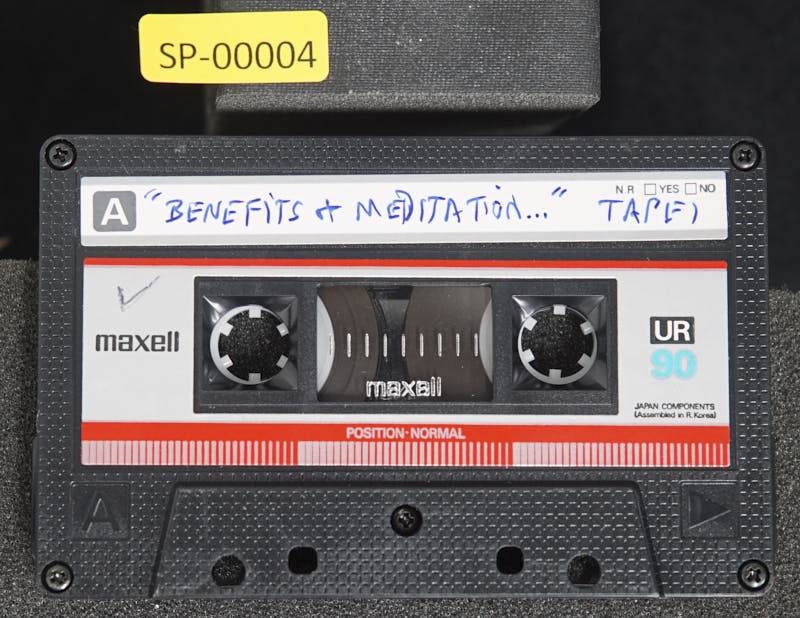
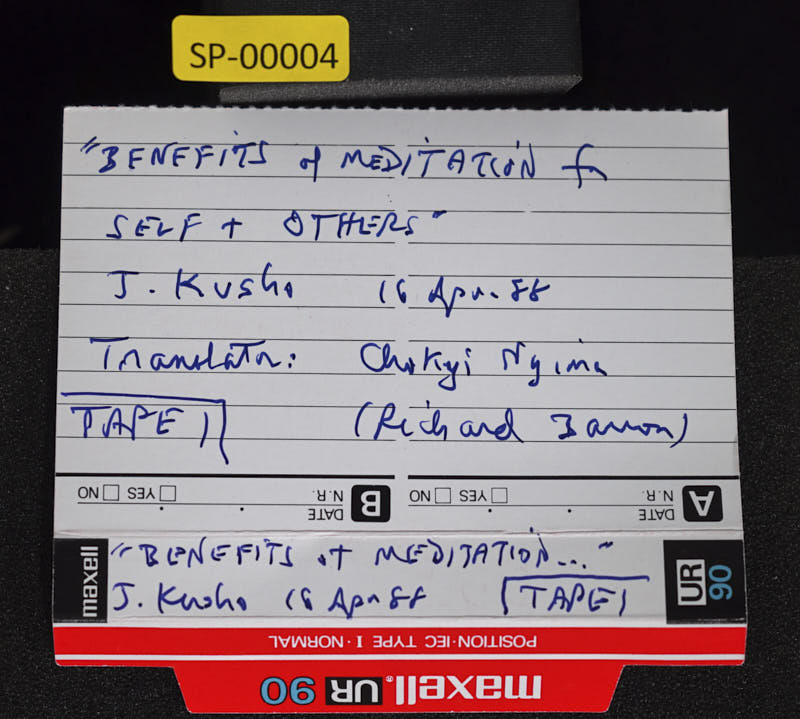
Benefits of Meditation for Self and Others
Taught by: Jetsun Kushok
Interpreted by: Richard Barron (Chokyi Nyima)
Thank you. Thank you. What's the position? [...] Thank you.
[01:14]
Thank you. [...] That's right. Okay. Okay. Okay.
[02:25]
So when I was born, I was born and [...] I was born. So at the beginning of the day, I've been asked by the people organizing this visit to say some words on personal practice that's benefits for yourself and for others, how to begin to apply the basic principles of Dharma. And I would like to emphasize at the beginning of this talk that most of what I'll be saying this morning will be purely personal observations. not a formal Dharma discourse so much.
[03:30]
It's just things that I found helpful in my own experience in terms of applying practicing methodical in a regular way. Now, most of you here, if not all of you, are practicing Buddhists. You've probably received teachings from other landowners of various traditions. So a lot of these ideas won't be new to you. They're not beginners in that sense. concepts and ideas will be familiar, which even deters. It's always helpful to hear even basic things over and over again. Personal practice on a daily level begins from the moment you wake up. That is to say, when you first wake up and begin to go through your daily routines of washing, preparing breakfast, and so forth, just taking care of your physical needs, That's also the time when you have the most opportunity and can derive the most effective results from personal practice.
[04:34]
If you establish a morning routine where part of getting up, as well as including washing yourself, dressing yourself, feeding yourself, once all of those needs have been taken care of, then you put aside some time to sit on your cushion and you should practice in a formal sense. When I was born, I was born. [...] In terms of establishing personal practice, there are some fairly practical
[05:50]
points which need to be taken into consideration. Things such as the environment in which you live and practice, the diet that you nourish yourself with, the kind of people who surround you, all of these are very important factors in determining the effectiveness of your practice. Traditionally, it's so that there should be purity of environment, purity of diet, and purity of companionship. And what this essentially means is that you find an environment as much as possible that does not cause you any anxieties or fears. You're not terrified of people burglarizing you. On the other hand, on the one hand, there's no fear or anxiety in that sense. On the other hand, you're not constantly subject to noise and distraction, especially when you try to practice. Now, this is the ideal, where you try to establish an environment that was as conducive as possible to quiet and the ability to get on with practice. Diet, again, can be an important part, that you maintain a healthy lifestyle and a healthy diet so that your general constitution is strong and stable.
[06:58]
You do not suffer from illness and debilitation when you go to your medication. And as well, the kind of companion that you choose are very important. People who do not disturb your mind with all kinds of afflictive emotions and do not continually cause doubt and distraction to arise in any practice, but rather people who are able to work harmoniously with you and be supports to your spiritual development. So all of these different factors of environment and diet and companionship and so forth are more important than we realize in terms of establishing good practice. And she said, we've got to talk. We've [...] got to talk.
[08:00]
We've got to talk. [...] This is especially true when you're engaged in formal practice, that the environment when you choose for your regular sessions of meditation as a practitioner are environments that are quiet, non-distracting, conducive to the cultivation of good meditation. So this means To the extent that you're able to, you choose an environment that is free of noise, free of distraction, free of any kind of influence or interference that might take your attention and your energy away from practice. Whether you're practicing in the daytime or the evening, the nighttime, whenever you set aside during the day time for your practice, you should try to ensure that the environment is as supportive and conducive as possible.
[09:07]
Are you all hearing this? Yeah, I think we'll have to do a play song so much. Yeah, it must be loud. They're coming through the box. Oh, I see. Oh, I can hear the noise. I'm sorry. Yeah. [...] Thank you.
[10:11]
I'm sorry. [...] Yes. Yes. Yes. The next important point that you need to pay attention to is physical posture.
[11:19]
And again and again we find reference in traditional literature that the posture should be comfortable. That when you sit on your cushion to meditate, as much as possible you adopt correct meditation posture, but it is meant to be comfortable. If you're in an uncomfortable or cramped posture, you can't expect your mind to develop good meditation. You won't be enjoying the process at all. You'll be fighting it all away. So as much as is possible, you keep the body erect. It's preferable not to lean against the wall or against some object or to sprawl the legs every which way or to lie down, but instead to be in an erect posture. But again, you have to take into account the fact that this is not meant to be self-induced punishment. You're not meant to be uncomfortable. So as much as possible, you combine the elements of erect posture with a sense of comfort and ease sitting on your cushion.
[12:37]
Now, this doesn't mean that there are certain postures which are forbidden. A person always has to take their own constitution into consideration. If a person has undergone some kind of operation or has some kind of physical ailment or weakness that prevents them, for example, from crossing their legs, and sitting for long periods of time, or means that they have to support their back for periods of time, then they have to be sensible about this. There's no forbiddance here. It's always a question of working with your own physiognomy and how you can best adapt that physiognomy to correct posture. So as much as possible, the person is in an erect, cross-legged posture. If that is not possible, then they work with their own... personal situation. This is something you don't often find reference to in traditional literature but it is an important point that we need to bring out that you should not impose a stricture on your body that makes you uncomfortable if that happens to be your particular situation.
[14:03]
You may wonder why there is so much attention given to something as prosaic as physical posture. But in fact, it has a great deal to do with your mental state. If your body is not comfortable, if you're not in a posture which is at one and the same time disciplined but comfortable then your mind becomes very tight very distracted a lot of thoughts and emotions fill your mind it creates a great deal of interference with the cultivation of good meditation and so it means basically that if you don't spend the time on posture the attention that's required for good posture your practice will not be fruitful it will not really become a path for you you will not experience the clarifying of your
[15:04]
natural awareness that meditation is supposed to bring above. I was born in a year and [...] I was born in a year. It's also a very useful thing to maintain a shrine.
[16:18]
And when you sit, to actually face that shrine is a focus for your devotion, for your meditation. It might be something as simple as a simple statue of the Buddha. If you practice a particular deity meditation, it might be a statue or a photograph of that particular deity, such as Avalokiteshvara or Tara or whatever. But to have some kind of focus is very useful, and also to place offerings out on a daily basis. Now, regarding the process of offering, it should be as pure as possible. both in a physical sense and in a mental sense. That is to say, you don't just throw anything on your shrine that happens to seem sufficient. You actually keep it very clean, very neatly ordered, very well appointed, well laid out. But again, it's important to realize that this isn't just an aesthetic exercise. You're not just decorating your home as something exotic or something...
[17:20]
and interesting by putting a statue and offerings out. It's a spiritual exercise, and so there should be mental involvement as this being part of your practice. So you're not merely setting up something nice, something aesthetically pleasing in your house. You're actually creating, helping to create that context for practice with your mind. And so the offering is a mental one as well as a physical one. You're not just setting out the art objects on the shrine, but you're actually mentally creating the sense of making those offerings. When I was born, I was born. [...] As well, when you sit down to practice meditation in a formal sense, it is extremely important to recall with a sense of renunciation that samsara, that the normal process of
[18:45]
cyclic existence that we now experience holds nothing but suffering that the basic or ultimate result of all of this is suffering in some form or another and this encourages you to seek beyond that and when you pray to the buddhas and bodhisattvas to your gurus as embodiments of enlightened wisdom is with this sense that through your faith and devotion you will come to transcend that same cycle of rebirth yourself that cycle of suffering As well, it's important to begin every formal session of practice with a renewal of the bodhisattva attitude. The motivation or attitude that your purpose in practicing is not just to benefit yourself, but to liberate all sentient beings, to liberate each and every living thing from its suffering. Yes. Yes.
[19:47]
Yes. [...] On the basis of this general
[21:11]
context of a very expansive attitude, embracing all beings, the welfare of all beings, then you go about your formal meditation. Now, regardless of the particular sadhana or the particular kind of practice you're pursuing in Buddhism, you'll always begin with the taking of refuge. This is a fundamental principle that runs throughout all Buddhist practice. Again, regardless of the particular technique, if you're performing any kind of deity yoga, whether it's Thara or Majjushri or Sarasvati or whatever particular deity you're meditating upon, the sadhana will always begin with some formulation of the refuge vow. And your attitude, again, has to be an all-embracing one. You are not taking refuge, you alone, as a single, solitary individual for a short period of time. But as you recite the words of the litany, you mentally You are doing so with the mental attitude that from now until you and all beings attain enlightenment, you and all beings take refuge in the Three Jewels.
[22:20]
So again, there has to be this greater perspective that goes beyond your own personal situation. Yes. It's a very difficult time to do it. [...] It's a difficult time to do it. I had to go to Massimba, and I had to go to the hospital. [...]
[23:24]
I had to go to the hospital. [...] It's worth mentioning at this point that this isn't an attitude that is only required or only to be cultivated in formal practice. This altruistic motivation of always taking the welfare of others into account as well is something that you try to cultivate throughout the day, to use any opportunity at work or in any of your daily activities as a vehicle for expressing that basic wish, that fundamental attitude, that through your own actions, others may benefit.
[24:27]
And this is particularly useful in view of the fact that we spend a great deal of our time during the day in various emotional states of pride and anger and jealousy and irritation with others and so forth. There's this continual barrage of emotions coming into our mind, which contribute very directly to our personal unhappiness. By allowing our minds to be continually afflicted by these emotional patterns, we set up conditions for further unhappiness. If instead we devote every moment that we can to cultivating more positive and healthy attitudes of mind, then we are directly working upon the causes of our day-to-day suffering, of our day-to-day problems and our day-to-day irritations. Because when it comes right down to it, these kinds of afflictive emotions do not create any kind of final happiness. They simply serve to further complicate the issue and to further create circumstances for our pain And so we can use our work, our daily activities, as raw material for training our minds in developing healthy attitudes.
[25:40]
And this boils down, essentially, to a non-egotistic approach. Whatever we take part in, we don't think of it from a purely selfish point of view. It's not simply what's in it for me, or I'm the only one who really counts in this situation. for taking into account as much as we can all the other people who are involved in it, whether they're our colleagues at work or members of our family or whatever, using each and every one of those situations to extend beyond our own personal concerns and to take into consideration the welfare of others. This kind of attitude is remarkably effective in smoothing the path and making one's practice both in a formal sense and in a day-to-day sense much easier. So, we have to go to the church. We [...] have to go to the church.
[26:43]
We have to go to the church. We have to go to the church. We have to go to the church. We have to go to church. Now, of course, minds are funny things, and they don't always do exactly what we would like them to do. And we're not to blame for that. It's not as though anyone's saying, oh, why aren't you like... such and such. Why are you this way and not that way? Why don't you change? We have to accept the fact that it is a process of gradual refinement or gradual change. No one is expecting anyone and no one should expect themselves to change like that. To just hear, oh, this is the way you should be. Why aren't you change right now? It doesn't work that way.
[27:45]
A person has to be willing to commit themselves to a long process of gradual change, of gradually refining and purifying their mind, rather than expecting that it's going to simply happen automatically through some magical process, or rather than assuming also that they're a failure because they can't immediately change. We have to allow that growth to take place in a developmental way. And this is often a problem because the teachings are often presented by lamas and teachers in an ideal form. Ideally, this is the way one should be. Ideally, one would be experiencing the world in such and such a way. And very often we find that people are discouraged. They think, well, I can't do that. And of course, at this point, they can't. But if they work at it, gradually they can. It simply requires that kind of patience and that ability to work with the situation over a period of time. Thank you.
[28:46]
Yes, that's it. [...] When I was born, I was born, [...] I was born, When I was born, I was born. I was born.
[29:53]
I was born. [...] In terms of developing this enlightening attitude in our lives, compassion plays a crucial role, but we need to understand what we mean when we say compassion because that can really go two ways basically. Truly vast panoramic compassion for all beings is an enormously powerful spiritual force. But what we often construe as compassion is, well, we have great compassion for our husband or our wife or our children, those close to us, those to whom we're emotionally attached.
[30:59]
But that isn't really what is meant in this context by compassion. Compassion goes far beyond our personal likes and dislikes. And if a person says, oh yes, I have great compassion, I love my husband dearly and I love my children dearly or I love my wife dearly or I love my friends dearly, That's not really compassion they're talking about. They're talking about their own attachment, their own personal likes and dislikes. And compassion is something that comes from so deep within you that it has nothing to do with your own personal likes and dislikes as an individual. So it's important that we draw the line between a kind of nominal compassion, a knee-jerk compassion that we might think of when we think, oh yes, people close to me, I love them now and I'll love them even more in the future and that's having great compassion. We need to understand that while Buddhist texts speak of compassion for your mother, for example, as a good starting point, that's simply because it's usually easier for a beginner to relate to having compassion for their mother or someone close to them than someone that, on a nominal level, they dislike.
[32:04]
But ideally, compassion has to embrace all beings, each and every being, whether we happen to like them or not on a personal level of individual personalities. Yes, sir. Yes, sir. And this is something which is more beneficial than we could realize, that we are able to have compassion not just for the people that we normally would like in an ordinary context, but even for our enemies, even for those people that we hate or would hate on a normal level. To be able to have true compassion for those people is an enormously beneficial force. Thank you. I would like to reiterate at this point that this is all based upon my graceful experience, that I have found this to be the case in my own practice.
[33:33]
That's why it's important. It's important to understand the language. [...] As well as a formal practice of meditation on a daily basis and as well as the various other activities that you are required to take part in your job and family responsibilities and so forth, try to set aside a regular time for study. We're finding that more and more authentic sources of teaching are translated now into the English language and so it's not as though a person doesn't have access to those teachings and they provide a very useful support for your practice to read these texts think about them deeply go over them again and again see what great teachers and great realized people in the past have had to say about practice and how best to go about practice if you read their life stories you see the kind of problems that they faced
[34:56]
the kind of difficulties they had to overcome, the kind of commitment that they were able to bring to their practice and the results that they derived from it. All of this can be enormously inspiring and also provide a great deal of helpful information in terms of sorting out your own practice. But it's inevitable that you're going to run into things you don't understand. You're going to read something that confuses you, a concept that really doesn't make any sense, and that is where the value of teachers comes in. To have teachers, lamas, gurus, spiritual friends, centers that you can go to, places where you can go to discuss your practice in a constructive framework where you can get good advice and through that advice come to better understand the concepts that you're trying to apply in your practice, the concepts that you're trying to gain realization of in your practice. Thank you. That's all.
[36:18]
When you're engaged in your formal practice, whether it's a deity meditation or some other form of meditation technique, you'll find doubts and questions arising in your mind. Is this really what I'm supposed to be doing, or is this really working? And that is a pitfall that you have to avoid with some strenuousness. The more time you spend brooding on that kind of thought, the more deleterious it is to your practice because the more you entertain doubt, the more doubts there are to entertain. It's far better for the time being to just drop that and continue with the practice and then make efforts to sort the issue out later on. But if you spend your meditation time thinking about, gee, am I making a mistake? Is this really working? Am I wasting my time? you're going to find out that actually you are wasting your time by paying attention to those kinds of thoughts. Instead, it's better to just drop it, to just dispel that thought and go on with the practice.
[37:37]
In the context of your own personal practice, you'll find that the most effective or the most straightforward way to go about your practice is to have is to discover some level of trust where for you your gurus and the three jewels the sources of refuge to whom you turn in your practice are principles that you rely on constantly it's not something that you simply evoke during formal meditation periods although that is important but in everything you do there is that sense of trust that sense of commitment that sense of this is something that I can give myself to wholeheartedly, to my gurus, to three jewels, this I can commit myself to.
[38:44]
And this is something that becomes an ongoing theme in your life, where it isn't something reserved for formal periods of meditation from this time to this time, but continues throughout the day in any activity that you're undertaking. And so both the spiritual and the mundane aspects of your life become permeated with this sense of trust and commitment. When I was born, I was born. [...] That's why we're here. We're here. We're here.
[39:47]
We're here. In general, particularly in a culture such as this one, people find that they lead very busy lives. There's a great deal that demands your time and energy in a culture like this one. And that is where the value of retreat comes in. To take time, make time, to go to a less crowded or less busy environment, to go off into solitude somewhere, to go with a small group of people into retreat. And for a week or two weeks or however long much time you can devote to your practice to actually create a context where you can apply yourself more of your time and more of your energy than you normally could to your practice. So it is again an enormously supportive factor in your practice to deliberately create circumstances for doing regular retreat.
[41:05]
In terms of how beneficial your practice is for others, this really depends upon your own motivation for doing that practice. If a person does anything with true compassion for others, in their heart, then others definitely benefit. There's no need to doubt whether or not it's effective. It is definitely effective. But it does depend upon the individual motivation behind the person's actions. ... Just to give a single example, you know someone who's in hospital, who's suffering from a disease or they're undergoing an operation or something and they're in that hospital suffering.
[42:21]
And you may feel that your own practice at home doesn't do them any good. But if out of a sense of compassion you're practicing for their benefit, longevity practice, medicine Buddha practice, some kind of purification, the fact that you have included them in your motivation for doing that practice is something that influences their situation. So even though you may feel as though you're very far away from the situation of that person stuck in the hospital, Depending on your attitude, you are capable of helping a great deal. It really depends upon whether you have that kind of compassionate or altruistic motivation at heart when you practice. This was something that was very prominent in Tibetan culture. very often people would sponsor a teacher or a group of people to perform a certain ritual or to practice or meditate in a certain way for their benefit.
[43:32]
Because it was understood that if the people had the correct motivation, then the power of their practice would not only be of benefit to them, but to the people who would sponsor them, the people who had encouraged and provided the circumstances for them to practice. When I think it's like a lot of people, I think it's like a lot of people, and [...] I think it's like a lot of people. In a sense, the practice of Dharma is no different from any worldly activity we might undertake. If we're trying to help someone in a totally mundane sense, we're far more effective than if we're just doing it casually without any motivation to help, without any thought of the other person's welfare.
[44:37]
But if we go into a situation and think, okay, what can we do in this situation to help so-and-so? We find that somehow the job gets done, that the person actually benefits directly. In that sense, Dharma is identical. The practice of Dharma is identical. If it is done with the motivation to help others, it is effective. Now, it's true that there may be very different ends in sight between a totally mundane act of helping someone and practice to help someone in terms of the ultimate goal. But in terms of the fundamental effectiveness, Dharma and the world are identical in the sense that if you go to it with the correct motivation, then the work that you undertake is effective. But to practice without true compassion in your heart means that your practice is not going to be effective.
[45:48]
You may think that it is, and you may try to tell yourself, oh, I really think I have the best interests of all beings and heart. But if you're just giving lip service to it, it really isn't going to be any more effective than a parrot just reciting something he's been taught. In Tibetan, there is the proverb or the example, the metaphor of a parrot who's taught to recite the mantra, someone sits down and just recites this to the bird until the bird remembers it enough to repeat it. But of course, the bird is not aware of the significance of what he's reciting. He's just been taught mechanically to repeat certain sounds, certain speech patterns. And so it doesn't have the same effectiveness as it would for someone, for a meditator, to understand the significance of using a mantra and to work with it with mindfulness. In the same way, if a person practices without compassion, then their practice is mechanical. It really doesn't have the heart that will make it effective. So at this point, Chetson Fusho says, I think I'll stop talking and ask if there are any questions.
[47:10]
And as I said last night, and as I say, every time I open the field for questions, if I know what I'm talking about, if I know how to answer the question, then I will answer you as straightforwardly, with as sincere an attitude as I can. If I don't know, then I'll ask . My question is, what situation should arise that would or whatever you think is not compassionate that day or [...] that day. I've never had the experience of truly compassionate. How does one more about quality? Awesome. Yeah, okay. So the question is, if one is not feeling particularly compassionate or one has never really experienced true compassion, how does one go about cultivating it now?
[48:17]
Yes, yes, yes. We had to go to the house and go to the house. We had to go to the house. We had to go to the house. We had to go to the house. They don't have to worry about it anymore. They don't have to worry about it anymore.
[49:18]
They don't have to worry about it anymore. [...] It's actually quite easy because on the one hand, while I said previously that personal like and dislike has no ultimate purpose in the development of compassion, I also mentioned and would reiterate here that it is useful as a basis for training in compassion. Compassion does not come automatically. It's something we need to refine and train ourselves in. And we begin with a relationship where it's very easy to give rise to compassion, very easy to see how the other person's welfare concerns us and is of importance to us.
[50:31]
If you have children, for example, You can see that when you think of your children, there's a qualitative difference in the way you think of other people. Your automatic response to your children is, I don't want them to suffer. I don't want them to have pain and problems. I want them to be well and happy and do well. So that's a kind of embryonic form of compassion. You can see that as the current... situation that evokes compassion most naturally for you and work from there. It may be your mother. Perhaps you have a very close relationship with your mother and your mother's health and welfare and happiness concerns you very deeply. And it's something quite automatic. Again, as I said before, these likes and dislikes, ultimately speaking, are not what compassion is all about, but they are extremely useful as starting points for us to at least begin to perceive and appreciate the quality of compassion in our lives. Because there is someone in some situation for whom we feel at least this embryonic form of compassion.
[51:45]
I'm meditating. If we're reaching a calm equipoise, is there a way to distinguish between a blank mind or a sudden equipoise? The question concerns when you're practicing and you're approaching or you feel as though your mind is entering into a state of calm equipoise, how to distinguish between that and a kind of blankness of mind, i.e., a healthy sense of calm balanced mind, balanced awareness, or the mind is kind of shutting down. Is that right?
[52:56]
Ben Tongri, which you did, you know? I am met, you know, I'm sick of it. You did it, you know? You did it, you know? You did it, you know? You did it. [...] I'm not going to do it. I'm [...] not going to do it. This is where the elements of devotion is extremely important.
[54:13]
When you find yourself meditating and you are experiencing something that you are interpreting as calm equipoise, At that point, if you invoke your gurus and the three jewels, the sign, the indication in your meditation that you are on the right track will be a kind of clarifying of natural awareness. There will be a sense of alertness about the experience, even though there is not actual distraction that thought processes have. necessarily, but the natural awareness of the mind will be clarified and sharpened. If you find that there is a sense rather of dullness or torpor, then you should again use devotion as a means of recognizing this obstacle and invoking the blessings of your gurus and the three jewels to offset the further reinforcement of this kind of
[55:18]
mental torpor. If you find that nothing seems to be working, your mind just seems to be blanking, better not to continue to practice that one. Better to stop. Because you can actually cause damage on some level. You can actually cause yourself real problems mentally if you continue to reinforce that kind of mental lethargy or mental torpor. So really the key here is the quality of devotion and the inspired sense of clear alert awareness that it brings about. It's probably a question in a similar vein, but how do you deal with moments in your life where your medical needs you legally, but you get curious about how you stress it when you can say that maybe life is worthwhile, gives you all kinds of guilt, because you don't know that way. I'm sure you want to talk about the similar vein anxiety states that are possible. Mm-hmm. So the question concerns states of depression in which the, well, as I understood it, it's kind of like as much as the teachings are telling you one thing, you're interpreting it in such a way that it's actually holding you back or depriving you of inspiration.
[56:37]
For example, you hear about how wonderful the human birth is and the potential that it affords. And you think, oh, why aren't I using it better? Why aren't I? I'm not doing anything with it, that kind of sense. Yeah, even like feeling worthless. Okay. That and periods of anxiety, periods of the distraction induced by anxiety causing problems. Is it during the meditation? Oh, obviously not. You're really trying to do it every day. Ah, I see. So you're making attempts at practice, but the general sense is one of... the question. Okay.
[57:46]
Just on this note of feeling worthless, just as a further clarification, do you mean that you feel being alive at all is worthless, that your life is worthless, or that your practice is worthless and you better just drop your practice? How far does it go? Pardon me? Ah, yeah. To an apple drop, you do it, right? Yes. [...] . [...]
[59:02]
And Justin Kushner said, well, my automatic response is to first encourage you to pray. Pray to your gurus, pray to the Three Jewels for inspiration. Don't just wallow in depression. You have to develop some kind of conviction, some kind of decisive quality in your mind where when you recognize that kind of depression and anxiety and insecurity coming up, you're willing to say to yourself, no, look, You're very fortunate. You've met with great teachers. You've received wonderful teachings. You've put a great deal of effort into this. You're not going to turn around and tell yourself at this point that it was all worth nothing. And in a certain sense, you just have to give yourself a bit of a talking to and keep going. And it really all boils down to that basic decisiveness in the mind where you can just say to yourself, well, I'm going to see it through. I'm not going to throw away that opportunity. So you have to be willing to think about the situation in a kind of clear or objective way, where instead of just wallowing in feelings of self-pity or feelings of lack of self-worth, self-integration, you say to yourself instead, no, I really do have a very fortunate opportunity here.
[60:33]
Think of the teachers I've met with. Think of the teachings I've received. Think of this whole connection with this path that I've established. I'm not going to throw that away. And then you just carry on from there. It goes without saying here that if you continue to entertain thoughts of depression and thoughts of worthlessness and thoughts of not getting anywhere, the only result in the long run is to just wear yourself out. All it does in the long run is make you miserable and deprive you of any energy that you might have had for real practice. So it's important to recognize it as it comes up and just cut it away. You have to have that kind of decisiveness in your mind. I have a lot of people who come to me. [...]
[61:36]
I have a lot of people who come to me. I have a lot of people who come to me. I have a lot of people come to me. If you're a person who can't practice simply because they don't have the time, if their circumstances require that they work so much that they don't have time or energy to practice, then that's what's depressing you. He says, well, for the time being, if you just keep beating your head against the wall and blaming yourself for not practicing, that's not going to get you anywhere. You can always look forward to your retirement, perhaps, and say, well, then I'll have the time to practice. Realistically speaking, in this culture, there is the sense, at least, that people have the opportunity, when they get towards the end of their life, past middle age, that they can put aside a lot of problems and have more time to relax. That's supposed to be what retirement's all about. So if nothing else, you could always look forward to that.
[62:39]
But to simply bemoan the fact that your circumstances don't commit you to practice, that doesn't get you anywhere. Um, this question concerns the topic of difficulty in life, and I understand that when some aspect of one's life seems to, appears to be collapsing. Mm-hmm. Periodically, I don't know if there was trees where my life would be collapsing. Mm-hmm. But it seems to, partly collapse if more throws up. Mm-hmm. All right. I understand the aspect that difficult to encourage as long as it turns towards conflict with practice. But I read and sort of conjugate a little bit that there's some other thing about, I mean, if they collapse, some kind of collapse comes itself, that it cuts ego.
[63:46]
We can't have that capability yet. When I find myself confronted with a situation where it really seems things are at least momentarily falling apart, I get all caught up in trying to hang on and, gee, things really fall apart. I don't know. It sort of seems very discouraging. But I had spent so much energy trying to hang on that it seems to, well, in a positive practice, I get caught up in trying to hang on. That would be very difficult practice. And I thought most of those periods No, no, no, I get your sense, yeah.
[64:54]
So these are inevitable periods of collapse where just circumstances go to the point where things start to fall apart and you spend more time trying to keep them together than just moving on. Letting it go and moving on to something else. I mean, it could even be the threat of being promoted and then being caught up above your head and you're not going to be able to handle the situation. And then one gets so busy, carnish. How can I convince him not to promote me? OK. . Pardon me? What? The whole question? The whole thing? Well, okay. You're really soft. Well, as I understood, the thrust of the question is that given that there are periods of time in everyone's life where things seem to be falling apart one way or another, financially or emotionally or whatever, there's some sense of chaos, of things.
[66:07]
You can't depend on them anymore. Things are breaking up. something you're used to is falling apart, that there is often the tendency to spend more time holding on to that situation and maintaining it, an impossibility, but you try anyway, to hold that which can't be held together together. There's more energy put into that than working more constructively with it and learning how to let go and move on to whatever inevitably becomes the next phase. Does that kind of say that? Oh, thank you.
[67:09]
We have a lot of food. [...] We have to do it. We have to do it. We have to do [...] it. If you've already understood or anyone has already understood that clinging doesn't help in the first place, why do we cling?
[68:31]
Why do we continue repeating something we know to be ineffective. This is the first time I was born. [...] . . . .
[69:31]
. When I was born, [...] Yes. Yes.
[70:32]
Yes. Yes. And given that we understand, at least on an intellectual level, on a conceptual level, that simply just automatic reaction of clinging to a situation as it begins to fall apart won't help. The other thing we should take into account is that we are directly responsible for our own happiness or unhappiness in a larger sense just in this lifetime.
[71:44]
The fact that we can experience anything pleasant, anything happy, anything good in this life at all is due to merit from previous existences. But We shouldn't think of merit and karma as some kind of fixed situation, predetermined situation. It is true that we have gathered merit in previous lifetimes. We have also destroyed merit in previous lifetimes. We continue to gather merit and we continue to destroy it. Especially destructive emotions such as hatred and anger in our minds are extremely powerful means of destroying Merit which otherwise would guarantee us at least some personal happiness or satisfaction. And so rather than simply bemoaning their fate, why am I losing this? Why is this falling apart? Why is this happening to me? And perhaps even getting angry or resentful and frustrated and therefore destroying further merit, thus depriving ourselves of
[72:54]
further causes of happiness, we would be far better to turn that energy into gathering merit, into pursuing practice and gathering merit, making offerings, doing prostrations and circumambulation, making offerings and shrines and giving generously to the poor, sharing the wealth that we have with others to benefit them, gathering the means that will assure us future happiness. If we're concerned with preserving happiness, then we need to go about creating circumstances for it. So once we've understood intellectually that on a psychological level clinging doesn't help, we can further understand more of the equation of why we are happy in the first place, why on a nominal level we experience pleasure and pain. And we can actually create the karma, create the merit that will lead to happiness and fulfillment and benefit. So it's really a question of understanding where those experiences are coming from initially, fundamentally, rather than on a symptomatic level, bemoaning the fact that something isn't happening.
[74:05]
If something's not happening, let's start creating the circumstances for it to happen. I'm beginning to get the feeling that the The way to deal with a lot of these defilements and obscurations is to examine where they're coming from and all of this. But there's also the way of wasting good karma where you have immediate anger or a misunderstanding that just catapults so quickly between two people that before you know it, you've grown a tremendous amount of karma. Or one person will take a stand, but they will just be unyielding. And you, in trying to relate to that, become the opposite. So is there like a quick fix? Maybe guru yoga, something that will really snap the situation. Sometimes you know what's right, and yet you're not acting on what's right.
[75:11]
It's more like you're on a railroad. So the question concerns situations where there's such an immediate negative response between two people just flying at each other's throats without either of them sitting to think the thing through clearly and realize what they're getting into. Is there some quick fix? Is there some method, visualization, mantra, whatever, or... Addressing those kinds of immediate situations so that the the the thing of mescalating cause a great deal of harm and karma well, yeah, yeah The social make up soup to me Keep it under the new move, but more cell good with on Pendle method, which needs a hug on a young, and it's some some global regime with any in the cheek each in a blamson see person in the loss of trouble shorting what is some of my time in some of those you know what long song you were? Mm-hm. Mm-hm.
[76:38]
Thank you. Yes, yes, yes, yes, yes, yes, yes, yes, yes, [...] When I was born, I was born.
[77:42]
I was born. [...] But there was a lot of money. We had [...] a lot of money. You get now the Guma-yewa-yewa-yewa-yewa-yewa-yewa-yewa-yewa-yewa-yewa-yewa-yewa-yewa-yewa-yewa-yewa-yewa-yewa-yewa-yewa-yewa-yewa-yewa-yewa-yewa.
[79:02]
There really is no magic mantra or magic formula for this. A person has to have the, first and foremost, this kind of immediate or sudden upheaval is a factor we definitely have to take into account, particularly if we have the type of constitution where we're likely to have a short temper and we're likely to fly off the handle. By and large, everybody experiences this from time to time. We just find ourselves in a situation, and before we know it, things are totally out of control.
[80:05]
And there's two ways we need to go about this. The first is to recognize that once something's finished, it's finished. There's nothing we can do about that. So there's no point sitting around thinking, oh, if only I hadn't, because you did. So at that point, it's finished. The important point is where you carry on from there. OK, given that I shouldn't have acted that way but did, I won't in the future. And that commitment to yourself is enormously meritorious and counterbalances the negativity that was generated in the first place. And of course, knowing who we are, it's likely that we're going to break that promising future. We're going to find that we do it again. And then again, it's finished. It's over with. The only constructive attitude that we can have towards it is, OK, I realize I shouldn't have done that, particularly since I committed myself not to doing that. Again, you just take up that commitment again. Again, I won't do that. I'll make every effort I can in future situations not to fly off the hand.
[81:13]
And so you have to, on a pragmatic level, you have to understand that given who you are, you may fall off the wagon from time to time. You may find yourself flying off the handle repeatedly. But you have to recognize it as a fault, that it's important, have regret. But the important point is the sense of commitment, the sense of, I can and will overcome this, and I will not do this in the future. And then when you do again, if you do, which it is perhaps very likely that one will, you still don't lose the initial intent. You don't say, oh, I guess this is useless, I'll have to give up, there's no way I can control this. You have to keep coming back to that point of, Yes, I can, and I will control this. Yes, I will avoid this in the future. I will not respond in that way in the future. Given that it's difficult to practice for a long period of time during the day, very busy days at some point,
[82:22]
And you set aside a time every morning, like just get up earlier. Whatever time you have to go to work, just get up an hour earlier to do that, be a pork box or whatever. Then many times this will lead you to practicing whether you're comfortable with it or not. It's always difficult. But the problem being, if you break the habit, you end up breaking it more and more. It's like if you quit smoking and then you just have one little tote, you know, to find out a smoker it can within six months, so an hour and a minute. The same thing I found in and out with meditation, that if you just absolutely commit, I will do an hour every day, come hell or high water, you're going to do it, you accomplish that. However, this situation may not be very conducted. At many times, you've only had four or five hours sleep, and you might as well be asleep, but at least you're making a commitment. I heard you say something regarding the danger of practicing and maybe not practicing when you do that.
[83:26]
How do you make that decision when you become aware that you're creating more damage than good by forcing yourself to try to do it? So it's a quality versus quantity kind of argument. You're putting in the hours or the minutes, but not... Not in the way that practice is meant to be done, but just because you're trying to hold on to that, maintain that, establish a habit. And how do you know when you're pushing yourself too much and actually creating damage, non-constructive rather than constructive? I'm ready to go. [...]
[84:30]
I'm ready to go. I'm ready to go. We have a lot of children. [...] Yes. Yes. Yes. Yes. Yes.
[85:38]
I'm going to take care of it. [...] I'll take care of it. We have to take care of each other. [...] We need to make sure that we're going to make sure that we're going to make sure that [...] we're going
[86:52]
@Transcribed_UNK
@Text_v005
@Score_40.26