You are currently logged-out. You can log-in or create an account to save favorites and more. more info
Realizing Enlightenment Through Sacred Visualization
The discussion focuses on advanced visualization practices within sadhana to transform visualization into realization, primarily through Vajra Sattva, Vajrayogini, and Guru Yoga methods. It elaborates on the profound practices involving visualization, offerings, and the significance of the Guru’s blessings in transcendental wisdom, emphasizing the ultimate realization of one's mind’s inherent purity and emptiness.
- Vajra Sattva Practice: Central to purification, involving visualizations of purifying negative actions through various forms such as liquids and colors.
- Vajrayogini Practice: Involves self-identification with Vajrayogini to realize the emptiness of inherent existence.
- Guru Yoga: Stresses the essential role of the Guru in realizing the true nature of one's mind, supported by stories like that of Naropa and Marpa.
- Sadhana Visualization Techniques: Detailed techniques for visualizing celestial dimensions and transforming sensory perceptions, explained through symbolic imagery, and practices aimed at cultivating merit and wisdom.
- Chud Practice: Technique to release attachments and transform the body into offerings, inspired by the broader tantric exercises.
Referenced Works and Authors:
- Hevajra Tantra: Cited to emphasize the necessity of the Guru’s blessings for realizing the ultimate nature of mind.
- Chakrasamvara Tantra: Mentioned in relation to visualization techniques and deity practices involving Vajrayogini, emphasizing letter symbolism rather than deity form.
Notable Figures:
- Stories of Naropa and Marpa illustrate the significance of the Guru in spiritual realization, emphasizing that even visions of deities result from the Guru’s blessing.
- Examples from Krishnapa or Krishnacharin, and Gantapa showcase the unique Guru-disciple dynamic and transformational potential of tantric practices through narrative examples.
AI Suggested Title: Realizing Enlightenment Through Sacred Visualization
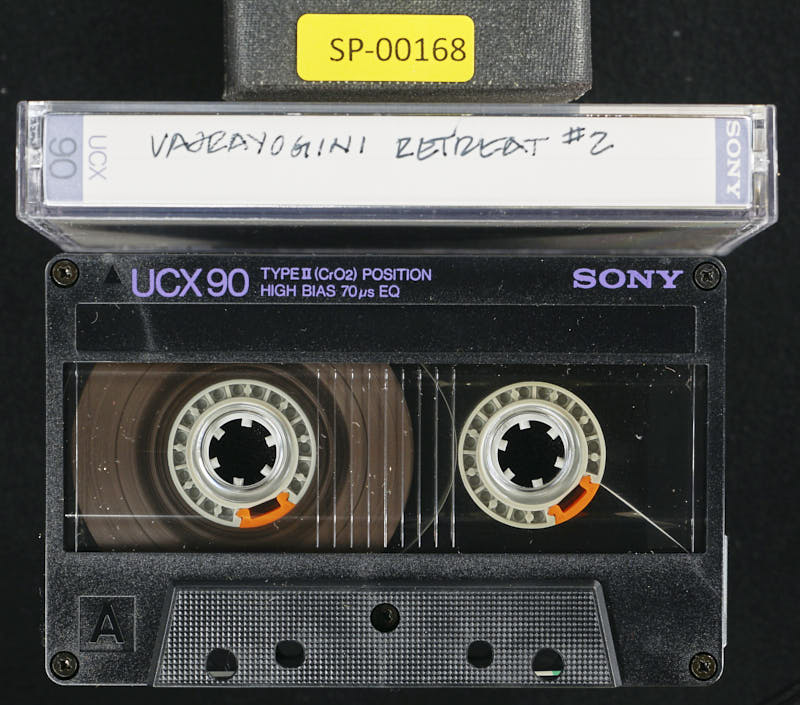
Same series as 00174
So basically, that's what we're going to concentrate on that part during this session. So what we'll do is start the sadhana. I won't go through a long visualization process for the refuge. We'll go through that, recite that 21 times, and then quickly move on to Vajra Satha, and then really concentrate on that. And then towards the end, then we'll go through the sadhana again very quickly, like we did this morning, and then we'll turn off and come in the session. So this is actually just to get a work from the pad of the sadhana really works with this. I came to the stage of Perfectly Enlightenment.
[01:01]
I must rescue all of the beings from the Great Ocean of Samsara, without purpose, and practicing the profound methods of Rashi Udini's Path. I am came to the stage of Perfectly Enlightenment. I must rescue all of the beings from the Great Ocean of Samsara, without purpose, and practicing the profound methods of Rashi Udini's Path. I am came to the stage of Perfectly Enlightenment. I must rescue all living beings from the very searchers of Sahaja, for that I ever stand by the seat of the bottom of the deck of the five-year-old beings back. In an instant, upon the top of the crown of St. Peter, there is a blessed one by the instructor, Sri [...] of the Lord of the Sixth Armament of Bohem, who sits with his feet of Christ and the God of the Son, and wears his crown and blasters with race, who is his immortal self, who sits on his back as a mother, whose body is white and covered, holding her at night and his father, and sits in the union of the Father, who has sinned upon whom is the Son of the Father's heart, who is the light of the Son of the Holy,
[02:24]
the way the light spread forth from it to implode the transcendental knowledge, which is the essence of our and the heart of our together, which, in the form of magnitude, is absorbed into them. O Lord, let us purify our way, our sins, our aspirations, fallouts, failings, and defilements, which I, in all other beings, have accumulated throughout the beginning of the cycle. Amen. of nectar, descends, and sends, and runs filled to the body of fire and water. And by the single piece of water, fills in the body of life. The nectar descends from the age of pride and murder, and the tender seed is hot on one's head to dispel all of these, and the liquid spirits, and the hope of these, and the relationship is born to smoke out of liquid with puffs and blood. And for as every incense, these eggs and figitudes of the apostles and sons were defeated, while the entire body becomes still the vector.
[03:27]
So then, going through the different types of visualization, first the purified illness, the vector is either white, red, or yellow, driving out illnesses in the form of black liquid, or also as black and pus. Then, to drive out evil spirits, the vector is copper color filled with raffledies, driving out evil spirits in the forms of small insects, or snakes, spiders, like this. And third, to purify karma, not just light in color and driving out black karma in the form of black tarot, or like smoke, and then taking the four consecrations. So, maintaining these visualizations, they will recycle mantra. study in the next verse with the four powers, which means first thoughts.
[05:07]
We're quickly visualizing Vibha Sattva with the concert on top of your head is the shrine when you're making your confession that all the misdeeds have done previously and you really regret strongly what you've done. So the power of regret. And then also thinking that you will never do such misdeeds unwholesome actions again in the future with the power of promising. And also through relying upon the shrine with the power of God and also promising in order to do such a thing again in the future that this rejuvenates or renews all your vows and pledges and also purifies you so that those were thoughts in my notes of the prayer. For broken and spoiled, laws and bounds, cruel and defective, be my refuge. To come, I stand and cry, possessed of the essence of great compassion.
[06:11]
To teach the things, I bring my refuge. I confess my doubts, as you are in the bonds and vows, the roots and branches, the bodies, each of mine. And as we do, I pray, all the humiliations of sins, all the failures of the grounds, So in this way, relatively speaking, we have done these misfortunes which cause us to have sickness and evil spirits to attack us and bad torment to ripen at this time. But actually, in ultimate reality, There is no bad deed that has been done, there is no one who has done this deed, and there is no result of the deed, there is no action of the deed itself. So actually the mind itself is temporarily covered over with these doubts and defilements of having done misdeeds, and also temporarily covered over with the idea of needing the necessity to confess these deeds.
[07:23]
But this is actually just the cover of the mind, that actually in reality the mind which produces these thoughts is pure by its own nature, and its purity is emptier than any conceptualization whatsoever. So, ultimately speaking, the ultimate confession, the ultimate Vajrasattva, means that your Vajrasattva's body, voice and mind, without him observing into your body, mind only merges with your own body, voice and mind. In this way, from the ultimate point of view, from the ultimate confession, there is no one who's committed a bad deed. There is no one who needs to be purified. There's no action of purification. So just concentrating or resting your mind in the state of purity, for when it says actually the one's body becomes pure, like a crystal egg, just means actually that your own mind from the very beginning is pure, and this purity of mind is empty, and this empty and pure mind and I'm going to merge together. So this is the ultimate madrasupple. They're actually meant for their lines. If you do four sessions, then the two morning sessions, you do the three
[09:02]
So in the afternoon session you do four and you do mahakala. Actually, usually it's about evening time when the sun's going down from offering to dawn. So at that time actually more, if you do more offerings, then you go to that time. And the evening again can be done. So here actually, generally mahakala actually has a very, very long formal offering, about ten pages long. But here's one paragraph to make it very simple, easy. So we begin again by blessing the formal. From the palace of the pure and beautiful, the very powerful one, he entered the palace of [...] the palace. Now, the short form of the Lord of Cemetery is we have together now.
[10:19]
So, actually it doesn't say here, but first you start, you can write in first, om, ah, [...] ah. From one's heart, light waves emanate, and in the sky before moon appears a wind envelope, an ocean of flood, above which is a vast surface ground. On this dress, mountain air of significance, on top of which are the four-sided pallets of skulls. Inside this, upon seats of lotus and sun, stand the glorious lords of the cemetery, fatherhood and mother, surrounded by infinite people, orderly consumed on them without penis. And it says, to establish them in their pledge to do the five paramudas, it says this again.
[11:25]
And then thinking after you're placing on your head things like Vajrasamayastham. Vajrasamayastham. Some means to establish them that they keep their pleasures. And then, again with the Lotus Realm Mojo, then this next mantra is the mantra offering to turn off. Om viraja viraja kumakuntis maha-pishachi sa-pare-vara idam-vanivit Buddha [...] Om Ge Raja Ge Raja Kuma Kuma Kuntis Mahapishachi Sarpariwara Idam Palingta Pujat Kaka Kairi Svava Sipane Vaichantu Svava.
[12:50]
Om Shmasana Pati Ardhyam Adhyam Kuspe I offer this holy adoration to the Mount, the glorious Lord of the Sacrament, [...] the glorious Lord of the Sacrament. Amen. We'll be right back. in the trauma offering the mantra offering the first half you do in the lotus round mudra and then about the middle of it then you stop and put it into what is known as the half open vajra actually vajra hands are like this so half open vajra hands means turns out so the lotus round mudra is just moving your hands in this manner so where you end the last mudra about halfway through just think about halfway through and put it in the vajra
[14:40]
fold your hands and then open it up. Okay, let's finish the term offering. Next is the term offering of the Dakinis. Om. It's on the page. Om. [...] Om Om Om Om Om Om Om Om [...] kha kha kahi thaihi svarayaksha rakshasa utha teka tishachi umada avasmara dhapa dhakiniyadaya imam vanim granantu samaya rakshantu hama sarasiddhane prajantu yatevam iteshtam bunjata jigita tipata
[16:08]
mati kramatha nana sarva karya satsukam vishitaya sahayika uvantu homo pepe sorha om ka ka kahi kahi sarva niyaksha rakshasa utha feita kishachi umadha avasmara gatha vakiniyadaya imam kalim vyantu Samaya Rakshantu Mama Swabha Siddhane Praya Chantu Yete Vam Teshtam Bunjata Jigata Hitata Matri Pyamata Mama Swabha Karyat Satsukam Vishudaye Sahayivah Evantu Om Te Te Sama Om Thakha Thahi Thayi Swabha Yaksha Raksha, Bhuta, Kveta, Kishachi, Umadhar, Apasvara, Dakar, Dakiniyadaya, Iman, Ramena, Vilantu, Swaraya, Nishantu, Mama, Swara, Svitamle, Trayachantu, Yatevam, Itishtam, Ujjata, Juketa, Vipata, Mantri, Kramata, Mama, Swara, Kariya,
[17:36]
Om A-Om. O Allah, with praise and scripture to him, protect the sangha, allow the venerable holy gurus to God, I pray again for my actions, in a fated world circumstances, obstacles with opposition to the last night's papers.
[18:43]
I am entitled to some of my sponsors, and may I call up some actions to be poured with God. May we be in our desires, and until my government is attained, as well as our protect and may we assist us against these secret activities. Thank you. Thank you. Vajraya Vajraya.
[20:40]
Whatever was incomplete and spoiled, and whatever my ignorant mind has others to do with myself, may the Master forgive all such. All that is and what is happening, residing in the ten directions, please obey ye to me, as long as all sentient beings who are equal and not providing nirvana. Until then, may the first not pass into nirvana, but continue to remain. We work so as to enter into these images, continue to remain the longest day in the distance of God and pride, redamaged by the four elements. God, continue to remain to determine to protect God, assist us, and our sanctity. Amen. To the transcendental aspect of the Torah gifts, who were God in the image, all they used to know all but his sons, such and beings, and yet for whatever the city has desired, may please go to the bottom line from which he came, and return to here again when requested.
[22:34]
Roger on. Put your left hand in front, and then turn face out. The hands face out. Roger on. Transcendental knowledge and transcendental aspects return to their natural abode, and the touch aspects are non-duly directed to oneself. There's actually a torment guest now that they're in the form that you visualize there.
[23:44]
And then we go back again to the site to finish up. Because now we're still in the form of Viking Guinea, but now it's a place on the armor of Ding Navida on page 62. Thank you. On day 63. On sunbang sunba. On sunbang [...] sun
[25:04]
Om Om Sumbani Sumbha Om Om Teh In the hand right Om Om Om Om Teh Left hand Om Om Om Om Om Om Om Om [...] I'm on my high-ho, but I'm on my high-high-high-high-high-high-high-high-high-high-high-high-high-high-high-high-high-high-high-high-high-high-high-high-high-high-high-high-high-high-high-high-high-high-high-high-high-high-high-high-high-high-high-high-high-high-high-high-high-high-high-high-high-high-high-high-high-high-high-high-high-high-high-high-high-high-high-high-high-high-high-high-high-high-high-high-high-high-high-high-high-high-high-high-high-high-high-high-high-high-high-high-high-high-high-high-high-high-high-high-high-high-high-high-high-high So that during your off time, whenever you're going anywhere, that you're always protected by these goddesses.
[26:08]
And actually, by then, the front means the east and above. And you're snapping, actually, the left hand. Usually, you snap it to the middle finger, but for this, I don't know the reason, they just said you snap it to the first finger. Generally, it's with the middle one, but for this, it's with the first. So first, yeah, it's hard to make it sound, but first in front and then up. And then, here it says, actually, to the north. So the north is on your left hand. and then behind and down, which means the west and below, and then to the south, which is your right. And then here, the east and south, so the south-east, then south-west, north-west, then north-east. And actually, it doesn't say to do it a third time, according to one of the previous Islamists, but with the threatening gesture in China, the third time, so it's sort of an oral tradition of people. So the threatening gesture is to put your thumb inside, this over and then extend the first finger and the other one slightly. This is called a threatening gesture. The threatening.
[27:11]
We did it once like this and once like this, reverse, and a third time with this gesture. So in the This is in the Buddha Yoga practice. The main Buddha, the root Buddha is in the form of Buddha Vajradhama. His body is red and colored, one face and two hands holding the Vajram ball, crossed over his heart, feet in the Vajram position, with nothing on his shoulder. The other, the lineage Buddhas are all in the form of Vajram Dhamma. They're in a circle surrounding him, all looking in towards him. And they're in the form of Vajram Dhamma, and the body is red and colored, the right hand holds the Vajram Dhamma, left hand holds the scalp up to the heart. on the left shoulder and then on the front and no feet across. So at one point, to all of them, then actually there's outer offerings which are made, which means like, first of all, offering all of our relatives and then enemies and people who are indifferent to it.
[28:17]
And this is actually to overcome our desire, hatred, and ignorance. Sort of actually offering our desire, hatred, and ignorance in the form of these people to the wilderness. Then we make other outer offerings within the flowers and incense. food, and then different types. Then we make the inner offering, which is the OM AH HUM, which is actually here, just all the naturally residing or naturally existing nectar in the world is offered to them. That's called the inner offering. Then here, the secret offering is that from our heart, many goddesses issue out. It says of Padma Bhatti in other classes. Actually, according to ancient Tantra in India, all women in the world, I think, were divided into three classes. One was called Padma Bhatti. Khipabam just means lotus and bhakti means race. And actually, it's probably a shape of body and sounds on the body of what class a person belongs to. So they would issue out and start dancing. And then all of them, actually countless, they start to absorb into each other until finally, like as many gurus as there are, that many Vajra-gidhis remain.
[29:21]
They all turn into Vajra-gidhis, the same number as gurus as there are. And then each one of them goes and sits in the lap of the guru to embrace him. This is actually the offering in the bliss of samadhi or the bliss of meditative trance in this actual form. And the fourth offering is the offering of reality, which means actually that there is no one who's offering, there's no one who receives the offering, there's no offering itself. So these are the four types of offerings. Crystal air. Crystal air. Actually, it just means that your body, basically it means it becomes very pure. It means that she's a mixture of light. And if a person is really purified, it means, like they say, the person gets a rainbow down, that's what it's referring to. You could really hold your hand up till the night, you know, like when we put a flashlight on your palm and sort of become real. It's like that, but really clear that it would just go right through it. That's not pure. We'll kind of go through the steps of what happens today.
[30:56]
We get the four consecrations. Then he comes in as a foreign flight. They're just with the bomb in our heart. Then we become Vajrayogini. Okay, first at that point, the letter bomb... At that point you were Vajrayogini, but very, very small. If you remember, what happened actually is that Vajrayogini came out from the essence of your mind in the form of Vajrayogini, about the size of your thumb. This comes out from the central vein. rises up through the top of your head. And she comes and starts cutting up your body. So your body disappears, but that little Vajrayogini is your mind. That one remains. So you're still there in the form of Vajrayogini, but that very small little Vajrayogini, that's all that's there now for you. And your body's been cut up and then purified and offered through all of those and everyone else. Then at the end, the Guru dissolves. So then the four consecrations come to you in that small form of Vajrayogini, that little Vajrayogini. Your consecrations are coming to you there as that form.
[31:59]
Then the Guru dissolves in that little glob of light. That enters into you as Vajra Dini right there. And then that letter bum in your heart emerges with that. And that letter bum just starts getting bigger and bigger. And you just think it fills the room. And your body sort of just becomes like a rainbow and the letter bum becomes like a rainbow. And just like you see a rainbow in the sky, then all of a sudden it just disappears. Then you remain in that state of emptiness for a while. And then arising out of that, Now you're going to do the self-creation of yourself in the form of a deity. So out of that you appear as Bajrugini now. She comes back down. Now here actually this time you just think instantaneously you become Bajrugini. And then in your hearts of letters A-A, and then that's going to dissolve again. It's like instantaneously you become Bajrugini. None of the things that enable the hearts of two letters A-A appear. And then the Dhamma kind of... Okay, and then inside that is the moon disk, and then the Marcha Rosary, another bomb. And from that, light raises you out, and then this body that we just became Bajogini.
[33:00]
Now again, that dissolves into a ball of light. And then from that, you appear as Bajogini. Yeah, I knew it's all in there, but it's not up here. It's here, but. I'm a civilist A within the heart, appears as a dharma kind. You're a double triangle. It's actually, the Dhammakara is these inverted triangles, inverted pyramids. That's, it says from two letters A, A-A, appears two inverted pyramids. Okay? Yeah. Actually using the same word, first it says Dhammakara and then it says two triangles. It's the same. Dhammakara is just the Sanskrit word. So what happens is you get a six-pointed star. Right. But it comes down to a single point. It's like a three-dimensional thing. Like an inverted pyramid with three sides, it comes down to a point. Then right on top of that, which is in your heart, you just became Vajragini. Then in your heart, the letters A-A, they became the two triangles.
[34:04]
Then the letter A came, that became a nundisk. On top of that, appears the letter Bum. Then from that, light resists you out, fill your entire body to purify you. And then this body now becomes like a ball of light, a huge ball of light. And then, out of that, you're going to appear as much as you're eating. Okay? I'm a little confused. The double triangle is flat, or it stands like this, inside which is the little bone. Or it should be, you know, like, flat, you know, like this. If you look at the top, if this was the triangles, this would be the double triangle here, when you look like that. But then it comes down like this underneath. So it's like this inside. Right inside your heart. So it looks like that. If you're looking down, you see two triangles. But if you look on the side, it's actually coming to a point, like a cone coming down. Then on top of that is moon disc.
[35:07]
Moon disc is a full one? Yeah, full. But it's lying flat. It's like a disc. And then there are Other Vajrayoginis, what, around them? No, there's 32 syllables. Now, each one of them, there's 32 syllables. Each one of them become one Vajrayogini. Vajrayogini. Right. Actually, what happens is the letter BUM in the center, it splits up, and that becomes five. That's why all of a sudden, actually, it's a very complicated system. I also don't follow it so well, but usually, this is actually a vein in the body, and the letter BUM, if you look at it longer, it just looks like a little stroke. That's all it is, a little stroke. If you look at it from another way, it's like a letter BUM. Very hard to see. Then if you split this apart, it becomes these four letters.
[36:08]
So from that one essence comes these five. Well, BUM in the center and then so then five. So then these become the five Bajuginis in the center. Red Bajugini in the center, right? Red. Yellow. And then around each of those 32 syllables now takes the form of Adyagini. And then later you take on these syllables. Actually, here they're not really the body mama. We wouldn't call them that. We would just say that they are letter, because they're not deities. They're the essence of these deities, but they only take the form of letters. Where it says, Red Onbamata Nevo is the essence of Vajra Varayhi. They never take the form of a deity. They're the essence of those deities, but in the forms of letters. And here, you should visualize the Mundus standing upright, and on there are written the letters. And that's what they are.
[37:12]
So they're really, in this case, not really part of the body nonetheless. Can we do these in image? Can we visualize them now? Sure. And even at the end after we do that, we never see them as deities. No. Even at the end? Yeah, always like that. This is actually part of the Chakrasambhara teaching. They use letters always, all the time. I saw one in Chakrasambhara, Long Sadhana. They must have about 120 letters all over the body. I don't know how you can visualize it all. But this is a system of Chakrasambhara contributions. They're always using letters more than babies. Kacchali, is that the same as the... Kacchali. Yeah, kachara, I think, is Tibetan and kachara is Sanskrit. And kachari means vajrugini. Kachara is her dhurra. Actually, there comes one of the mandalas of Chakrasambhara.
[38:23]
which is, it represents actually different, almost in a way you could say it's like a body, I mean it's just transforming parts of the body into, we're seeing them in their divine form. Well Ravi, no, actually Bhairava there actually is one of the worldly Hindu deities. according to one of these women go up to the world. But the eye ending like that shows it's female, for one thing. And actually, again, it's just one of the goddesses of one of the Chakrasanbara mandala somewhere, where these goddesses were sort of like, sort of worldly goddesses, but then brought within the mandala to be transformed into the blind beings. Again here, actually, it should be a long eye of the second, so it's a female. These are all females here. So it actually could have been his concert or something like that. And again, she was brought within this mandala.
[39:24]
Usually they'll have stories of how they were brought within it, subdued in a sense by one of the deities and brought into the mandala and then put on the path of enlightenment through that. So generally speaking, they're sort of broadly deities which are transformed. And a lot of deities have the same names. You can't always say it's the same one. There's a lot of different yamas and there's a lot of brahmas and hindras, but it's not always I think I just missed the one point that you mentioned in proselyabhi. So the cutting of the body, you know, up into the baby. And what's remained there is the... Yeah, actually, first that one, the Vajrayogini comes out, and then she looks down at you. The Vajrayogini is the essence of your mind in the form of a small thumb-sized Vajrayogini, which is your mind. This comes out, and then cuts you out. So at the end, what's left is that, and that's your mind. So this body is now finished, but that mind, the Vajjyugin, or you in the form of Vajjyugin, your mind, that's what takes the initiations and the consecrations.
[40:31]
That's what's left until you dissolve into emptiness, if you end the Buddha, you're welcome. Well, I'm still a little confusing about the process. The process, she comes out. Okay, she goes up where, you know... She sets your navel, and she comes up through the central vein, through the top of the head, and then she comes and looks at you. And in the right hand, she has a curved knife. And then with that first knife, she touches you here. In the small, where you can test the motion? Oh, she just touches you with that knife in her hand. Just touch. By just touching it, all of a sudden this comes off. Half of the head comes off. And then in front of you, there's three skulls, like a dry skull, you know, in the form of a tripod. And then this one comes down and is placed up on that. And then all of a sudden it just becomes big. Actually, you should think it just fills the entire world. It grows larger and larger. And then she comes, and with that knife, first she touches, like, your ankle, your knee, and your thigh. And just by touching it, each piece falls off. And you think actually she just throws it right into the skull. And then she does the right leg like that on the knee.
[41:32]
And then, you know, just picks up and throws it in. And then she cuts around the waist, so the middle part of that again throws in, and then cuts this midsection, and the upper section. And then she cuts the arms in three places, and then the neck, and then this part which is left now, and also that goes in. And then you start om ahom haho shri. And by doing that, you think that underneath this tripod, there's a fire, and the fire blazes up very great. It starts to boil. So all of your body inside that starts to heat up. And all the impurities which you have, all the impure substances, they burn off. Just like if you heat butter, all the impure substances, the butter, more often the really clear, pure butter remains. So all this stuff burns off. And what remains there is this very pure nectar. You think actually it's very cool to the touch, white and color. That's a very nice... And then what's left now is your mind in that little bhajur-gina. She stays. She stays where you are. She comes and sits where you were sitting. Stay here, even though it's a cataract.
[42:33]
That's your mind, because you're thinking about it. And then from your mind as bhajur-gina, that little one, many, many goddesses come out and they pick up nectar and offer it to the guru. What do they call that? Well, there's a system which is called chud. Chud. Chud. This is not a pure chud practice. It's sort of like chud. A real chud practice deals a bit more with ritual and also a lot of tune and music if you have a certain chance for that. And generally that's done, it's a bit of a more violent practice because one thing you're supposed to be out in a cemetery somewhere at night. And also who you're offering to, you want to invoke very violent spirits and ghosts and really bad things. In this case, we're not really doing that. It's more to the guru and to... peaceful deities. There actually what we want to do is to really try to invoke and bring in a very terrible place like a cemetery some really violent spirits and give them our body. So basically this thing is slightly different. But what's the significance of that? To get rid of your clinging to evil.
[43:35]
What is all the evil in you? Well, every evil you see in this world is actually a manifestation of your mind. So you're cutting up your body and giving yourself away to your own hatred. And by doing that, you're getting rid of your hatred. And especially this cutting practice is supposed to be really equal. Especially the point. Yeah. It's a very violent practice. It's a good part. But in the church practice, when they're really inviting these, is that to tame these other spirits? No. To tame yourself. Because actually it says very clearly in the scripture, if you tame your own mind, you tame every other spirit as well. So it's a reverse process actually. But also if you can make offerings to them and do it in a proper way, let's actually tame them because they can't hurt you anymore. You're in tune with them. Thank you very much.
[44:41]
Thank you. So this is sort of a peaceful topic. But also usually in Cho, what happens is they have these very big drums and there's a very beautiful chant to it. But they like to chant because that type of chanting is supposed to, it's a method actually invoking different types of spirits. And certain types of people or spirits in this world or beings, they're attracted by certain sounds. I mean, we have certain types of music everyone likes and draws you together. So also for Cho, there's a certain type of tune which is very nice to draw different types of spirits, you know. That's why it becomes a little more complicated. And there's also some types of different aspects of the children, which I didn't really study. I was on page 92 of the Dakini of a total offering. What I was wondering is if we could get on tape that
[45:44]
The way I pronounce it, though, is slightly different than other people do usually. I mean, I've written it more in Sanskrit form. Actually, the first part where it says, That's all actually invoking, just to invoke all the Bakinis. This refers actually, normally speaking, there's five kinds of the Bakinis, so this is referring to invoking them. What I'm making the offering is om kakha kahi kahi, svarayaksha rakshasa, bhuta peta vishachi, unlabhat, abhasmara, bhaka rakiniyadaya, imam valin janantu, samayarakshantu, mamasvarasiddham ne prayacantu, ite vam ite shtam, bunjata, jigata, pipata, Thank you. Actually, the first half of Earth Panther, the thing we gave out this morning of the preliminary Chama offering,
[47:07]
Not necessarily to that. Yeah, I mean here actually, it's just eight different types of, these are more earthly type of spirits. I don't know, like marids or water spirits, tree spirits, earth spirits, different types of spirits that cause madness or cause you to lose your breath or to make you lose your memory. So there's, actually in some scriptures it says there's 84,000 races of this. And here actually there's a very simple way to classify in eight forms. And these eight actually have been subdued by the Dakini's in order to help people practice, practitioners. But here that's why you say actually I offer these things, I even prostrate to you, because they're not ordinary anymore. They've sort of been subdued and brought into your path. So they become like hard somewhere. So anyway, that long mantra of the Dakini's, the first half is just
[48:19]
saying who these are, saying, now you're under these pledges and having been under these pledges, you have to remain there, and then I'll give you this kind of offer, and I'll give you this, and me, and wine, and this and that, and now I'll take that, and then do your job, you know, protect me. And then after that, it says Buddha, Dakini, Vajra, Dakini, and Ghatma. These are actually the five classes of Buddhists, the five transcendental, or five Buddha races, and each race has its own Dakini within it, in relation to it. Thank you. Three messengers at the end of the servant. Yeah, three messengers, generally it means that that's the... The three types of Vajrayogini? Yeah, that's right. The Sambhogakaya Vajrayogini, the Manakaya Vajrayogini, and the Mantra Don Vajrayogini.
[49:21]
Sambhogakaya Bajragini means the one who lives in Afanishda, who resides there, who you invoke. And the Nirmana Kaya Bajraginis means, like all the Dakinis and Vedas who live in the 24 holy shrines or the 8th Santa Fe, going to pilgrimage places. And mantra-born Bajraginis means, actually, by the light rays that you're going out from your heart to purify everyone and transform them into Bajraginis, there are mantra-born to their three messages. No, I have another question to ask another day. When we were doing the Vajrasattva, and we did it, there were the different visualizations, and the first one, with the different diseases, the cold and the hot, the hair, the things.
[50:29]
What comes into it? It's actually a Tibetan classification. In a very general way, any kind of disease which arises from about the waist up is called a hot disease. Hot? Hot. So I think even colds, you know, lung diseases, these are actually hot diseases, as far as I know. Because actually it arises due to too much heat within the body. It's like kind of an inner heat. so the body's out-balanced because of excessive heat. For example, like if you get tonsillitis or tight clothes, foods are actually caused by heat, too much energy. Cold disease is generally referred to things below the waist, but also, say, including kidneys, so any kind of urinal infections or even swelling of the diets or things like this. These are actually cold diseases, rising from cold, or if the body becomes easily cold. There's not enough heat in the body. There's a lack of heat and excessive cold.
[51:30]
And air diseases generally are like dizziness, mildness sometimes, unbalanced. These are some examples, I don't know so well. What blood diseases do you mean like that? There's also classification. Probably there you just add it together with the air diseases. Are there breathing exercises for air diseases? Usually for breathing, not. I mean, not for air disease. A way to help air disease means the body's not heavy enough. So there's lightness of the body. So the good thing, one reason maybe cause is because of the body. So it's good to take meat if you have air disease to make the body heavy. Meat, potatoes, or even fat, meat fat, you know, make a soup out of it. It brings the body down. And I've seen people actually respond that it's just you know, they're too lightheaded in a sense. So it can be caused from different things, like loss of blood also causes that. So actually when you lose too much blood, actually air is rising in the body, so it's coming up and actually causing lightheadedness.
[52:36]
So to replenish the bladder and make your body, actually you have to make it almost a bit heavier to bring it down, actually this brings the air in the body also down, inner air, and different types of diet actually helps that. And that's only one thing, a factor. So usually air types of practice won't because then, because your air is already out of balance, it'll take it in a worse way. No, because actually when the air is out of balance, I've seen people try to fast or like have done a half day fast when they had air disease. All of a sudden their ears start ringing and then they get loud and sound going through their ears. That's also air disease. means there's too much air in the head, or too much air rising in the body. And that's caused actually by not enough fluid also. In some cases, I mean it depends on factors, but usually someone with an air disease shouldn't pass. I've noticed one woman actually, she was saying also, she always had like when she did meditation and things, or even she was translating elsewhere in Europe, she was translating from English into German.
[53:50]
And just due to concentration, she would get a lot of headaches. and air in this, you know? And she tried many things with her, so what I told her one time was to do the Vajrasattva meditation. And when she'd do it, she would concentrate on her and it would get worse, you know? So I told her to bring the air down to her stomach, and then concentrate, instead of concentrating on the nectar coming into the top of the head, bring it all down, bring your visualization right down to your navel, and then bring it down with everything pushing out and pushing down. And that, it helped to subdue it when you brought the air down in the body. And like when you're concentrating a lot, after you're getting lightheaded again, so the air is going too high, and then it's easier. Sometimes that also happens if you do too much sadhana, too much mantra recitation, so you become a lightheaded. And also, for certain people, different times of the day will affect them. I find that, especially after the sunset, it's easier to become a little less airy, or a little more airy, just to move another world, or move another shift in the day. So you bring that down.
[54:51]
I think actually, with food and things, you have to experiment yourself, because everyone's body is different, so how different foods will affect your body, you can see how to help yourself. What is it? This is called lung. Yeah, lung is air. This is very similar to teaching music. It's Chinese medicine. It's cheaper than medicine. Yeah, but the principles are the same, by the way. The divisions of the diseases and the way it affects the body, this is actually Chinese, it's the same. I experienced that at the end of the Saturday night, when I visualized the Vajra, the small one from the navel, and I sense along the central brain and then the ball of light absorb and then free, you know, the central vein and the love, Rasa and Dala not absorb into their body, you know, the sense, you know.
[56:08]
And if you reach the top of the head and then, you know, goes up to the kachara and it's kind of a, you know, like a, Just concentrate on your head and your headache. Well, that time, actually, that point, you should think, actually, you don't have a body then. But how? Make your head a little lighter, you know? I mean, don't concentrate it as a physical form right there. Just keep your body, make yourself more airy at that point. You know, less solid. No, it's all right. I mean, what you're doing is right. I mean, it's not wrong. You mean the ball is supposed to be visualized as like a neon light, you know, like with no both, you know, just a light body, is that what you're saying? Yeah. A rainbow body. Actually, I've seen it somewhere. It's almost like, what do they call those lights, you know, when they flash in the sky?
[57:09]
Like right at the end of it, you see. Yeah, a searchlight. You know, at the end, it sort of looks like a little ball at the end. That's it. That's what you are at that time. There were three veins in the center of that. The three veins, when they come up, do they go up like this and then down? The central vein goes right up to the top. Right. And the two on the side, they come up to the top and they curve down. They come down right within the skull and then they come down right to the top of the nostrils. But when they absorb into the Vajrayogini, they sense... You know, it's like a spider. You know when a spider is in a web and she drops down, and then there's like a thread of the web that comes down. When she comes up, she brings that web into her. It's like that. As the spider goes up, as the Vajrayogini goes up, the web, the veins are going into her. So the spider, when she gets to the top, that thread's not there anymore.
[58:14]
And neither is the rest of the body, right? The rest of the body goes right up with them. Well, at that point, you're not the body anymore. It's just a glow of light. So actually, what happens is the veins, the legs and the arms absorb into the body, and then the body becomes like a ball of light. And in the center of this ball of light is three veins, the body being in the center one. And as she goes up, the lower light comes into her, and also the veins underneath of her also come up into her. And as she comes up, the veins become shorter and shorter, and the light also absorbs into her. And finally, she's right at the top of the hill. It's just fine, and then she goes off, and then there's nothing behind. Well, the Lion Air has a flag. That's right. Is there any...
[59:15]
I think it's in some of the tantras, you might get more in the chakra, some other tantras. Because the Vajrayogini Buddha Ram, it's not like Amitabha's Buddha Ram. It's very different. This is more of a mental state than a physical Buddha Ram. It has a certain different type of quality to it. Although there's stories, actually. Sarchan, Sarchan Nisargiazo, he was actually very famous for Bajragini teaching. He's the one who started the Sarva subsect of Sakya. So Bajragini liked him very much. She would come down to visit him. Then one time there's a story where from Kachata realm, this one staircase came, a spiral staircase came down. It was made up coral, red coral. And came down and she walked down there. And she asked, starting to come back with her. He said, no, I can't go yet. He said, actually, he wanted to write some more commentaries about Bambra teaching. He said, still, my mother's alive. I've got to wait until she dies.
[60:19]
I said, I'm not coming now. Well, no, Bajugina was very disappointed. She walked back up the stairs, kept looking at him. But he was very good. He had no trouble getting there later. Yeah. Let him take a break. Thank you. So, we're going to do the last session tonight, so we're not going to do thermal offerings with this. So, since we don't do thermal offering, we don't do the womb blessing to start with. There's the need for the womb blessing in the blessing of the shrine is only when you're going to use it. So actually, already we've taken the water off the shrine and taken it outside and thrown it out in a clean place, so we don't even need the shrine for this session. If you want to burn up his incense, it's fine, but actually there's no real need because there's no actual offering, any outer offering going on, or so.
[61:27]
I mean, there is a sadhana, but not invoking a deity outside and making offerings. So what we're going to do this session Still, in any session, of course, you have to start with prayers to the Guru. And then what we're going to do is to do this on that we'll do 21 recitations of the refuge and 21 recitations of the Vajrasattva. And what we'll concentrate on this evening is the Guru Yoga. And actually this Guru Yoga has a few special things in it. So this is not generally the way it's done. We're going to repeat a few things inside of it just so you really get familiar with what it's like. So we'll start the Guru Yoga as it is during the Satana on page 52. And the first part is to create the shrine in front of us and do that as a normal. Actually, the prayer for recitation for counting at the 100,000 is the prayer found on page 54, where it says, to the root preceptor of great kindness and the most perfect and holy land preceptors, please bestow always your blessings on me throughout the course of all my lives.
[62:31]
That, actually that place, we're going to stop and we're going to chant that for about an hour. just that far, to release the blessings of the Guru. And this is actually a prayer that we use for chanting, for accumulating the numbers. Then after that, we'll go on with the sadhana to make the outer inner and secret offerings and real offerings. Then this offering kusali, we're going to do it a few times because actually it's a very important practice. So what we'll do is actually we'll do this kusali offering, this is the one of cutting your body. Like we'll do that whole visualization up to the point Actually, we just do it once together, you know, by reading it out loud together, up to the point where you make all the offerings to the Buddhas. And then we're going to go back and everyone will just do it themselves about two more times, just to get the feel of the visualization that it's really like, because actually the text also says that this is a very special method for accumulating merit and also transcendental wisdom by understanding this practice.
[63:34]
So we'll do that a few times. And then we'll go on with the Sagnar after that to receive the fourth consecration. And then at the end of that, on page 58, where the body, the Guru is absorbed into your body and another bum expands, that one paragraph, again, we're going to concentrate on for a few times just to get the realization. And then we're going to stop there for a while and do that meditation. I don't think it's at that point. Because it says in the scriptures that the only way that you can understand or gain the realization transcendental knowledge of the true nature of your mind is by the blessings of the guru in fact there's no other way to do that i mean you need the proper causes conditions but it's through the blessings of the guru that this really arises and it says actually that it's an instantaneous arising that when we have a real connection with the guru when our own mind is ripened and our karma is ripened and we have all the causes conditions which means that the accumulation of merit and accumulation of wisdom through such a practice as this then actually we can tune our mind into the Buddha's mind and then that's the real transmission of our point.
[64:36]
And this is actually expressed in the sadhana here actually by the Buddha observing into your body and then another bump expanding and dissolving. This really is basically what it is, is the nature or the negative part of the mind itself. And the mind itself is actually the Buddha from the ultimate point of view. So we need the outer Buddha just to give us that blessing or to make that connection. And then we see the inner Buddha, or the real Buddha, which is actually the nature of our own mind. So this whole Buddha Yoga practice is just for the purpose of that, to gain that realization. It's the purpose of doing all these different types of offerings, and especially the Kamsali offering of cutting the value, is just to ripen our mind, to gain merit, to accrue the proper conditions, by which then we can really meet with the true Buddha for our own mind. And it says in many scriptures, such as, like, Hivaja Tantra and others, that it's only by the blessings of the Buddha himself that this will arise. So that's why we'll concentrate on this part here, doing this practice tonight.
[65:40]
That's the way we'll do it. And then after that, we'll go right through the sidewalk again more quickly, as we've been doing the last two sessions today. So, is there any question on that first? Please, no. Actually in Tibet also, it was said out in India that many people would just practice Guru Yoga as the main practice. So here actually in Sadhana such as this, what they do is emphasize Guru Yoga. That's why the whole, this long Sadhana Islam is just basically because of this Guru Yoga practice in order to gain access to other Guru. And it's through this practice actually that many people in India in Tibet have actually gained realization just through Guru Yoga itself. as a very special and very holy practice. One of Dejan Rinpoche's Buddhas, who's also named Dejan, Dejan Ajahn, his main practice actually was just Buddha Yama. He didn't do anything else, basically. Taking a prayer such as that one, he would recite about 10,000 times a day.
[66:43]
And everywhere he went, anything he did, he just believed everything was the Buddha. If a bad thing happened to him, it was like the testing of the Buddha. It was a guru praying in a violent form. something good happened to him, it was the blessings of the Buddha for him, the Buddha could again, and that's well. But everything he did, he just taught the Buddha. And actually through that, he would have a realization himself. But he was in retreats for many, many years. So that's why actually this, in this practice especially, the Buddha was emphasized in a very big way. And this actually was written, this text actually was written by, originated by more of a who had his own little lover, who from whom he received absolutely special blessings, and would have gained his realization. Guru Yoga is always very important. And actually in some ways the essence of the entire Vajrayana path. Because it's through the Guru that we enter into the path, and then also through the Guru, a way that we really doing blessings. Maybe just as a story, one time Naropa, his main disciple, one of his main disciples was Marpa, actually the founder of Kharbusa.
[67:47]
And Marpa one time was in India with Naropa, and Naropa decided to trust him in the Guru Yoga practice. So, he ran across the Hivaja, the entire Hivaja mandala in the sky, and Naropa was sleeping. I mean, Marka was sleeping instead in the house. So, Naropa caught him and said, Marka, he said, wake up very quickly because your Yidham is in the sky. You better come out and see him because you never see your own deity. So, Marka was very stubborn. He woke up and he ran outside and saw Hivaja in the sky there. So, Naropa said, who do you prostrate to first? Do you prostrate to the Guru or do you prostrate to the Yidham? So Marka thought, you know, every day I can see the Guru. It's not every day that I can see the Yidam. So he said, maybe I'd better prostrate to the Yidam first. So then he prostrated to the Yidam, and then he prostrated to his Guru, Naropa. And Naropa said, actually, it's only because of the blessings of the Guru that anything arises, and actually even the manifestation of the Yidam is only the Guru's blessings.
[68:49]
And then at that point, the Yidam, the Hidraja dissolved into life, absorbed into Naropa himself. He said, actually, the Yidam is nothing but the Guru himself. He said, you've made a mistake. You're wrong. He said, actually, it's the Guru. He said, actually, at that point, he gave a verse, he said, without the Guru, actually, even the word Buddha cannot be heard. So actually, the Guru is the real source of the entire teachings and through the source of the entire, especially the Vajrayana path. So it's through the blessings of the Guru that anything can arise for you. So he said, for that reason, actually, you have to work very hard on that. So that's why I actually also gave as a prajtanta sasam guruyaya, within this practice of God we need it. So we'll concentrate on that now and we'll do these updated practices within the world. Okay? So first we'll recite the lineage prayer to start the sacrifice. Finished? That's it. I have two questions. In page 79, the last, the last second of, uh, Demsos?
[70:05]
Demsos just means a city for women. That's just, actually, also in that prayer, there's stories about how God's beginning to save, or help other people. Each one actually has a very long story. It says that she embraced Gantatap. Actually, he was a great Indian guru. And he, I don't remember the story very well, but he was going to be killed at one point by someone. And then he manifested in the form of Chakrasambhara with Rajagini's concert and showed actually his power. And showed actually through the Rajagini teaching or Chakrasambhara teaching that he was enlightened. And the one of Kusale actually, it says actually Kusale is the one there who was, we do the practice of Kusale. Which is like, it's an interesting story because it was said actually one time there was one great Indian guru by the name of Krishnapa or Krishnacharan, who actually also has a lineage of Chakrasambara teaching. And one time he was traveling in India and he came up to the Ganges River.
[71:09]
So here it says actually in the prayer, it says, Reverend Kusale on the banks of the Ganga. So actually, he was traveling along with this guru, with some of his disciples. When they got to the banks, there was this one old woman there, who was really ugly, and sort of had many sores and things on her body. She was a leper, very diseased. So she came up to the guru and said, please, he said, you and your disciples are going to cross the river now. So please put me on your back and carry me across because I can't walk across this river. So the guru thought to himself, actually, I'm a very great being. And I have to help many sentient beings. So if I carry this woman and I get this disease, then it won't be a benefit to others. So he thought, maybe I shouldn't carry her. It's of less benefit. So he said, no. He refused. And then one of his disciples, his name Kusali, was a beggar, a poor disciple of this guru. And she asked him, he said, will you please carry me across the river? So he said, fine, hop on my back. So he started going across.
[72:11]
And when he got halfway across, she transformed into Vajurini. took him by the arm and took him away. So, the woman will actually fail in my case. Oh, Kusali is a beggar. Kusali actually is a Sanskrit word which means beggar, but actually also is the name of this one person who has gained realization through his compassion throughout the world to this woman, actually manifested in this form, in this ugly thing. That's why sometimes also in the chorus it says, sometimes in the world of illusion, which means the world of samsara, you appear as a demoness, or sometimes as an ugly woman, sometimes as a beautiful woman. So God, you take different points. Yeah. On page 54, when you did the chant to the root receptor,
[73:11]
I wanted to get clearly again what that visualization was of the root receptors here before us and of the others around you. I mean, to give a general idea is that from the place between your eyebrows about three feet in front and three feet out, it's about there that you want to set your mind to direct your mind. And the visualization, you can make it very big or very small, whatever's comfortable for you, but sort of in that direction, sort of in the space in front of you. And right in the center there, there is a line supported through a throne. There is a lotus, sun, and moon. And on top of that, in the center, is the Guru in the form, the root Guru in the form of Guru Bacchadana. The one from whom you received the initiation and the teaching. Any teaching that you practice, The Lama who gave you that specific teaching, for that teaching is your root guru.
[74:13]
So that's why also when we make offerings, it says also at one point to the root guru, we make the offerings to the lineage guru, the line gurus make the offerings. Then it says also to other gurus on the third line. What line gurus means? Well, line gurus means, well, from Bajra Dara to Bajra Vinu, to Naropa, to all these ones who came up to the present one, those are the line gurus. So lineage gurus, right? So also later it says to the other gurus, so it means actually any other teaching that you receive, you also have other root gurus. So also you make offerings to them. So then in the center is the root guru in the form of Buddha Vajradhama or Vajradhama. So he's like this. He has his hands crossed over his heart holding a Vajradhama bell. He's red in color and his feet are crossed in the back position. And then surrounding him, so starting in front of him, so the back to you, is Vajradhama. and then Vajrayogini, and then Naropa, and then the Pantene brothers looking and shedding certain models like this. Each one, one after another, just in a circle, all looking in towards him.
[75:18]
But all of them actually, here in the form of Vajrayadharma, which means their body is red in color, but the right hand holds the diameter, the right hand holds the skull cut to their heart, and they have the katana staff on their left shoulder. And there, each one of them are in that form, completely surrounding him and looking towards him. disagree with that concept? Actually, no, because here, when you put it here, actually, holding the Vajran and Dhal cross represents their union with concert. The other ones in the form of Dhirva-jadhara, Dharma, have the Thangastha, that represents that, because Thangastha represents the concert. So by symbol, they all have, but without sort of a manifest symbol of female concert union. One more question. On page 58, when the bliss, when the bliss becomes through the crown of our head, we're the small, larger human.
[76:24]
That's right. And it comes down through our head, and then the bond, as it enters the bond, the bond becomes large. Does it like sort of... goes through us and go out of us, or we become Raj, too? Well, actually, you can do it either way, actually. You can just think you also become Raj. It's sort of like then, actually, what you do is discontinue the visualization of yourself, of Rajivini. That sort of just disappears. And then you just really concentrate on that bum. And like the bum, you know, it's sort of like a square shape. You've got a bum in Tibetan. If you do it in English, it's okay. But like that, then it just becomes bigger. You know, you just see it becoming bigger. So you're really concentrating on that level, which is your mindful. Because also the form of Rajivini is your mind. It's a mind form, especially here, because it's the one that came out, the essence of your mind. So you can see your mind in the form, but you can see your mind in the form of a letter bump. Either one is valid here. So here, actually, what we do is just take our mind off of the form of a body unit, and just concentrate, oh, that's the letter bump. So just let the portion sort of dissolve, and then just keep your mind electric to that bump.
[77:26]
And see that really in the form, and then see it just get a little bigger, a little bigger, and then really expand until, like, you can just see a huge letter bump filling this room. And then it goes outside and then it just becomes bigger and bigger and bigger. Then finally it dissolves. And then when it dissolves, you give a good explanation of how to hold that. Can you explain it again? Yeah, here actually the purpose, all these practices throughout the whole teaching, even with Refuge, Vajrasattva, Buddha Yoga, or the Meditation Yon-Thought, all of them are for the same purpose of getting to the nature of mind, the true nature of mind. But here what we can do is sort of emphasize the true nature of mind from a certain aspect like for example at the time of refuge we can concentrate on the nature of mind which is always the same case of being clarity, emptiness and the combination of two but there we can categorize it like the clarity is the sangha, emptiness is the dharma the combination is the buddha like this so here for Buddha yoga practice and especially because it's through the Buddha yoga that we really can very quickly gain this understanding of nature of mind
[78:32]
But the clarity of mind here we can see, place it as faith in the Buddha, because the functioning of mind is the clarity of mind. What clarity of mind means actually is, we can say actually the characteristic of the mind is its clarity. And this clarity of mind is non-ceasing, it can never cease. The clarity of mind we have now, which functions and sees this world, this is an impure, aspect of clarity of mind, but it's that same clarity of mind, it's that same continuity of mind which gains enlightenment. It's only one continuity, one link, one lineage of mind. So that's the clarity of mind, it never ceases. Now it's impure because it's covered over by defilements and we see things impure. When we gain Buddhahood, it's the same clarity of mind, but it's been uncovered, or it's all the impurities have been uncovered. So here actually what we want to do at the time of Buddha Yoga is to use the clarity of mind But here to manifest it in the form of faith. So that actually we can make that link, a very strong link with the Buddha.
[79:33]
So it's best actually just to leave the mind in a clear state without any thoughts. It's just like actually if you have a pool of water and when you agitate there's a lot of dust in it. If you let it settle, it goes down, but there's still a pool of water. That's the clarity of mind. And then when it's agitated in this time, when we're sitting there trying to rest our mind and it's clarity, if it's agitated, then make that agitation in the faith, in the Buddha. As soon as I sit, then immediately take your mind away from whatever you thought of. Maybe you think about your house or something. Then say, this is faith in the Buddha. Change that thought into faith in the Buddha. Settle the mind in that faith devoting to the Buddha. Keep it until it becomes like that pure Buddha. And then we check the nature of that mind. Like when we check the nature of Buddha, we check the nature of mind which has been settled with faith. Then actually we can't find it. It doesn't have a color. It doesn't have a shape. It doesn't have a place. It's not born. It doesn't cease. We can't do anything with it. We can't find it in any way. So it's completely empty of any existence of its own. And also it's anti-abonagous.
[80:36]
It's just not real. There's nothing we can hold on to. So that emptiness, actually, we're looking for that emptiness. We found that emptiness. So who's looking? That's the clarity of mind. So that one that's looking here, he found it. And then he came here. So the clarity of mind is the looker, but it can't find itself. So when that thing can't find itself, but it's still looking, that's when they do, that's when they merge together. And that's called the combination of clarity and emptiness. So here we're sort of merging faith and emptiness, clarity and emptiness. And then actually when we can get that, we let the mind rest in that state. Because if we get that and hold that, that's grasping. And that doesn't work for us. That's also an impure conceptionization. So when we can see, when we can get the mind to restless clarity, then search for what that clarity is, and we can't find it. Then when we get that point, then we just let the man rest. Sit there.
[81:36]
No grasping, no one who's meditating, no one who's looking, no one in style, nothing in style. Trust the man resting in style. And if we disturb that, faith in the body. Give faith in the body. If you need to, think of him in the sky again. He becomes a ball of light, enters into your head, merges into a letter bombing, becomes big, rested again. If you need to do it originally. Keep him coming to you again and again, till you make the name. And keep resting your mind in that state. Thank you. One time we visualized, before we do yoga, we visualized a celestial dimension. Are we inside that dimension? That's right. Actually, what you can do is think the entire universe is one celestial dimension. But instead to see this celestial dimension in front of you, it seems like it's external. I mean, you can also, the idea actually is really that you're within this entire, because the celestial dimension is created from your own vision.
[82:38]
I mean, the vision of your own, of ultimate reality. So actually you're not excluded from that reality. You're still within. So then in that case, it's good to place yourself within it. I mean, actually, it's in front of you so you can really see its shape. I mean, you have a feel of what it is. I mean, it's like a square. It's a square building. Actually, it's square and it has three stories on it. The ground floor is square and the next one is sort of a square. And then on top of that, there's a square again. And it has a static roof on top of the head project. So inside of that, all the Buddha's are sitting. So actually, it's good that you're also, I mean, that you're part of that, that you're with him. Actually, the ones above, they don't have flooring. See, actually, what happens in this celestial mansion like this is that on the ground floor, it's square outside, and then each side has one door on each side of these. And along, on the sides of each door, there's two pillars that come up, so there's four pillars.
[83:39]
They come up on the side, and then it comes across, and it says there's four pediments. Four pediments actually means like there's four steps, ledges on top of the doors. One is bigger, nothing smaller, smaller, smaller. And on top of that, is a lotus, and then down the wheel, and then two gears, and then there on top of them. So each door is like that. This is square on the bottom. Then in the center of that, there's like eight pillars in the main directions, like east, south, northwest, and intermediate. And then on top of that, there's like a curved beam that goes around from there. And from that curved beam, so the center part's empty. From that curved beam, a ceiling comes up. So actually, what happens is from If this is the floor down here, in the center this is empty, and then this flat thing goes off to get to the edges of the walls. So if we look up here, there would be a circle in the middle of the building here, which would be open. And then, inside of that circular part, there's two vajras.
[84:43]
One vajra goes this way, a second vajra goes this way, and then two come across this way. And in the center of that, there's that square line where these two meet. where the four bodies meet, this one, like that then. And where they meet, another root, or what do you think, rock comes up. A level, that's right, with the rock. So that's square again. So actually, if you're right in the mud or below, you look up, you can see straight up to the top. So then that means it's all empty. But the body has a square. The next one, so it's round because of the beams running around. On top of that, it becomes square again for the third floor. Then it has a root. Does each wall have five different colors coming out? If we do it in a very long way, like according to Hiraja times, it says like that. And then each direction will have a different color for it? No. They're all one in each direction. Outside the wall is on one color. Inside? Inside also one color.
[85:43]
The floor will change colors. The floor actually in the east, it'll be like if it starts in the center, the east is white. The south is yellow, the west is red, and then the north is green. Same as the colors in the polar value of these. That's right. Because those colors, for most of the countries, I think the color of chocolate is slightly different, but generally most of the countries are the same. They have different, actually they represent elephants, they represent the Buddha races. When we do the visualization of the technique, how do we somehow dismiss it? How do we visualize the world of the other sort? At the end, then, actually, first, light rays from his heart is Shura and Tatcha, all the sentient names around you, forifying them so that they all become Pajrugini and then disappear the rock that we get around.
[86:50]
Then he himself, it's almost like literally from the throne upwards he starts to dissolve in the light and from the top of the head downwards also becomes light. And then he becomes like a little ball of orange light, or red. And that little ball of red light now comes down and goes into the top of your head and merges with your heart. And at that time your own mind and the triple gemmerge together. And then visual, and then consciousness. Well then there's the creation of life and thought first. you're going to do this practice for the sake of all ascension days and then invite yourself so tonight then what you should do remember in this practice actually there's a sleeping yoga so make sure you do a sleeping yoga when you go to sleep actually from now on until you sleep think that you're about your healing but when you go to sleep There's two ways to do it.
[87:51]
It says in the book, I do it too. If you want to do it in a state of emptiness, just lie down to sleep and think this during the form of Vajjoginian, there's another form in your heart. It's like this, you ask on this, you call it out of the world of existence. I don't know, I think it dissolves into light. This is absorbed into your body, Vajjoginian. And you and Vajjoginian from the top of your head down, and from the feet up, all dissolves into a red light. This is working, let it form in your heart. And then this itself also just It vanishes, it becomes very small, and it vanishes. It's like a rainbow. And if you want to do it in a different way, then you can think actually that where you're sleeping on the floor actually is a big double triangle, which is actually what represents the celestial dimension of our journey. In the central left, the bed that you're sleeping on is a dual turn. On top of that dual turn, you yourself and the film about your unique line on your side. And then just above you, so if you're lying this way, just above you, and a little bit up, is the Guru himself, you know, you're a Guru, in the form of Buddha Bajaj Dharma, Buddha Bajaj Dharma, it doesn't matter, he's sitting on a throne in Lotus, in Mungas, he's sitting there, you know, Guru, and thinking that you're in the form of Bajaj Gini, and thinking of a quick devotion to the Guru, that he's there, protecting you, and watching over you, and just go to sleep.
[89:10]
And then, if you're doing this form, if you wake up in the middle of the night, the first thing you should think is, And then you go back to sleep. And if you sleep in the emptiness, you can't get up. Is that true? And then when you get up in the morning, if you're in the, if you're sleeping in this emptiness state, then as soon as you wake up, just immediately think, I'm brought to you in here. Very quickly, just like that. and just reappear in Vajragini. And if you see anyone around you, you also think about Vajragini. And then also, if you're doing it in the other form, when you wake up, think actually that the Guru is in front of you, you're this Vajragini, this room that you're in, is the double triangle, and everyone around you is a form of Vajragini also. Men think the Guru dissolves into light and is absorbed into the top of your head. And in this way, actually, you become very clearly when you see yourself as Vajragini.
[90:13]
Well, in between, like in between these last two sessions, I was doing a number of practices. And this morning, people started a lot of practice. Well, actually, the essence of all deities are the same. I mean, because they're only one essence, They can take different forms. So for the purpose of keeping your commitments, you know, to do other sadmas, then during that period, you just, you know, just stop for a moment, do the other sadma. And then as soon as you finish your sadma, then again you think on Vajrayogini and then keep that thought in mind. In all seriousness, if you really do wake up on a normal night and you do the Vajrayogini, would you consider that you woke up as Vajrayogini? and then do it again as you move back to sleep?
[91:16]
Actually, what you could just do is just think actually the nature of all appearances is really emptiness itself. And then just try to sleep. And if you want to do the whole thing again, you can. But actually, if you want, in a very simple form, just think actually, well, I invite you to get the nature of emptiness itself. And then, actually, in the morning, you want to do nectar tasting. On top of this mantel, there's a piece of paper with some nectar fills inside. So I'll just take one. and I can have the blessings with you. Thank you. What time is the sentence? It's basically six to eight, and then what? Nine to eleven. Nine to eleven.
[92:12]
@Transcribed_UNK
@Text_v005
@Score_46.75